



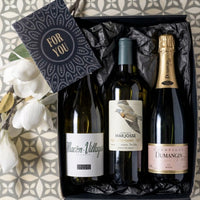
Champagne & Two White Wines Christmas Gift Box & Wrapped
Unwrap the joy of Christmas with premium Champagne and two white wines, beautifully presented in a gift box and gift-wrapped for the season. A thoughtful festive gift for wine lovers, perfect for sharing at holiday gatherings or surprising someone special.
1 x J. Dumangin Fils 1er Cru Brut Rosé Champagne NV ~ Champagne, France
Forbes Magazine ~ "The Best champagne you've never heard of."
Decanter (UK), Steven Spurrier ~ Best Sparkling Wine
93/100 Tyson Stelzer, Champagne Expert and Author of The Champagne Guide
93/100 Bob Campbell
92/100 James Suckling
Bob Campbell ~ "Best selling wine. Rich, mellow, fruity - lovely wine. Very pretty pale pink."
Hospitality & Thirst (NZ) ~ "Delicious and fragrant, full and rich,..... a beautiful champagne"
New Zealand Herald (NZ) ~ "The producer's best selling wine .....a very classy drink."
James Suckling ~ "Bright playful red fruits and cassis with some gently spiced biscuity notes. The palate has an attractive vinous presence, plus long cherry and raspberry flavors. Fine and smooth."
UK Telegraph, Victoria Moore ~ "What I've Enjoyed Drinking this Week"
Wine Align, Julian Hitner ~ "A beautiful experience, enjoy over the next three years or more.....The best-selling wine of the operation, the NV Rosé (sourced exclusively from Premier Cru grapes from Chigny-Les Roses) delivers great expression, balance, and delicateness... Elegant scents of grapefruit, delicate yeasty biscuits, minerals, and a hint of dried herbs and spice. Complex, with excellent fruit (very stylish), balanced acidity, and a vibrant hint of grapefruit and minerals on the finish."
This beautiful Rosé Champagne (sourced exclusively from Premier Cru grapes) is pink champagne at its best! It is Gordon Ramsay's restaurants' best-selling Rosé champagne and out-rates the big name champagnes at half the price.
J. Dumangin Fils are one of France's most celebrated boutique champagne houses. J. Dumangin produces exceptional Champagne from their own vineyards in the acclaimed region of Chigny-les-Roses, South of Reims. Dumangin is recognised by the prestigious French wine guide, the Guide Hachette des Vins as a leading producer. The bible of the French wine industry awarded the Dumangin Grand Réserve a Coup de Cœur. The Coup de Coeur (judges' favourite) is the Guide Hachette’s highest possible recommendation.
Champagne is the most iconic sparkling wine in the world, produced in the region of Champagne in France. Synonymous with celebration, champagne is typically produced from a few specific varieties of grapes: pinot noir, chardonnay, and pinot meunier. With effervescent flavors of citrus, almond, and apple, champagne comes in varying levels of sweetness and has a moderate amount of alcohol. The most treasured Champagnes age for a minimum of 3 years.
The Champagne region is located 140 kilometres from Paris, France. While the vines in this region have been producing wine since the Roman era, it is only in the past couple of hundred years that winemakers began producing Champagne using méthode champenoise - the complex method that produces the style of Champagne the world knows and loves today. Another important component of the production of champagne is the chalk and limestone soils which dominate the Champagne region. Vines grown in these conditions result in wines that are high in acidity - a key component to making good sparkling wine. Champagne's northerly location - about as north as grapes can ripen - also allow for higher acidity and lower alcohol levels which are also very important for producing quality sparkling wine.
1 x Georges Duboeuf Macon-Villages White Burgundy 2022 - Burgundy, France
Bronze - James Suckling (2020 vintage)
Bronze - Wine Spectator (2020 vintage)
Bronze - Decanter World Wine Award (2021 vintage)
Silver - Decanter World Wine Award (2020 vintage)
James Suckling "Apricots, cooked apples, papaya and almonds on the nose. Full-bodied, ripe and fleshy with a creamy texture. Easy finish." (2020 vintage)
Wine Spectator "A fresh white, with peach and apple flavors accented by lemon and floral notes. Balanced and juicy, with a lingering finish that echoes the orchard fruit." (2020 vintage)
This wine is produced by Les Vins Georges Duboeuf which is one of the largest wine producers in France founded by the late Georges Duboeuf who was affectionately known as 'le roi du Beaujolais' (the king of Beaujolais) or sometimes pape du Beaujolais (Pope of Beaujolais). Les Vins Georges Duboeuf produces a staggering 3 million cases of wine annually. The company is most well-known for its popularization and production of Beaujolais wines. In 2018 Georges’ passed control of his company to his son Franck Duboeuf, who is considered to be one of the key specialists in Beaujolais, its terroir and its wine, and has shifted production to focus more on Beaujolais Nouveau.
Mâcon-Villages in southern Burgundy, France is an appellation that in select communes of the Mâconnais wine area produces dry white wines made from the Chardonnay grape variety. These wines represent a step up in quality from the standard Mâcon title.
Burgundy (Bourgogne in French) is a historic and highly respected wine region in eastern France. Burgundy wines have long had devout followers throughout the world and continue to do so today. Although Bordeaux produces about four times as much wine every year, Burgundy’s estimated 74,000 acres (30,000ha) of vineyards are considered to be of equal importance, producing some of the most exclusive wines on Earth.
The two key grape varieties of Burgundy are Pinot Noir and Chardonnay, both members of the extended 'Pinot' family of grape varieties. There are others too, of course, like Aligoté, Pinot Gris, Gamay, and Sauvignon Blanc but the primary focus of Burgundy’s production is Pinot Noir for Bourgogne Rouge and Chardonnay for Bourgogne Blanc. Located in the east-central part of France, Burgundy has 5 primary wine-growing areas; Chablis – “shab-lee” Côte de Nuits – the night slope, Côte de Beaune – the slope of Beaune, Côte Chalonnaise – the Chalon slope, Mâconnais – the region of Mâcon.
Chardonnay is one of the world’s most popular grapes, Chardonnay is made in a wide range of styles from lean, to rich, creamy white wines aged in oak. Bolder, richer, full-bodied and buttery Chardonnays are made using oak and are produced in California, Burgundy, and Australia. Unoaked chardonnays such as Chablis and those produced in Chile, New Zealand, and other parts of France are leaner and often crisp and minerally, with delicate flavors. By law, if a label says “Chablis,” it must be Chardonnay.
1 x Chateau Marjosse Pierre Lurton Cuvee Palombre White 2020 - Bordeaux, France
92/100 James Suckling
Owned by one of the world's most famous winemakers, Pierre Lurton - president of two of Bordeaux's best-known chateaux, the Moët Hennessy Louis Vuitton (LVMH) owned Château Cheval Blanc and Château d’Yquem.
James Suckling, ''..I like the density and concentration, with a delicious creaminess undercut by herb and spice...Almonds, fennel, yoghurt, grapefruit and pear skins on the nose, with some cloves and white pepper.''
Château Marjosse is owned by French 'wine royalty', Pierre Lurton - president of two of Bordeaux’s best-known châteaux; the Moët Hennessy Louis Vuitton (LVMH) owned, Château Cheval Blanc and Château d’Yquem, Château Marjosse. Pierre Lurton comes from two of the great Bordeaux families. His father Dominique was the youngest son of the paterfamilias François Lurton; his uncle André Lurton who founded the eponymous wine company; his many cousins run châteaux from Pauillac to Pomerol. His mother is from the famous Lafite family.
The influential Club Enologique asserts that Pierre is the most accomplished wine personality of his famous family. Trained as a doctor but swapping his studies for wine making after four years. At 23 he took over Clos Fourtet in St Emilion, one of the fine Lurton properties, and in 1991 he was appointed head of Château Cheval Blanc (it was bought by Bernard Arnault of LVMH in 1998); in 1999 he took on Château d’Yquem, which had just been added to the Arnault portfolio.
Club Enologique describes Pierre Lurton as having the world’s most corporate wine job. "However he divides his time between two of the world’s most exalted wine properties, but comes down to earth in Entre-deux-Mers, the leafy, unpretentious appellation to the east of Bordeaux at Château Marjosse."
The Château Marjosse estate is located in Entre-deux-Mers, on the right bank of Bordeaux. Initially owned by the wine merchant Bernard Chénier, Château Marjosse was acquired by the Deleuze family, who, in 1990, gave some plots to Pierre Lurton to rent. In 1992, Pierre Lurton, who grew up in Château Reynier, neighbour to this magnificent Chartreuse, moved to a second home in Château Marjosse and, over successive years became the owner of the entire vineyard, as well as the Chartreuse in 2013.
Decanter "Since Lurton bought Château Marjosse in 1994, the estate has improved beyond recognition. Pierre's father, Dominique Lurton, also made over a further 30ha so that, under the Château Marjosse label, Lurton now exploits 42ha of vineyard, six hectares of white and 36ha of Bordeaux red – a total of 300,000 bottles a year. Pierre insists his wine is Bordeaux and not Bordeaux Supérieur because ‘my wine is only supérieur in the bottle’. His objectives are ambitious. As the quality of the terroir with clay-limestone soil is similar to some of the better areas in Saint-Emilion, he hopes to prove that wines from this area can rival those from more prestigious regions."
Sommeliers International "At Château Marjosse the land possesses yet another specific feature, known locally as “la Boulbène”, a silty-clayey texture that has developed on ancient alluvions. The fertility of these soils no longer needs to be proved, because, by chance, they are also found in Saint-Emilion, a terroir that is extremely familiar to the man who manages “Cheval Blanc” …. Pierre Lurton. Assisted in this transformation by Consultant-Oenologist Pascal Poussevin, whose recommendations range from vine growing to wine-making, Pierre Lurton’s estate has now reached its cruising speed … Beyond the fabulous adventures he experiences in his role as manager of Châteaux d’Yquem, Cheval Blanc, as well as estates in South Africa, Latin America and in Australia … it is undoubtedly with “the salt of this land here in the Entre-deux-Mers” that his years of quest for perfection will be revealed. It is clear that this region needs winegrowers of such calibre, those who possess a sixth sense and, using techniques that almost resemble intentional alchemy, transform the grapes they touch into wines that exude the unique character of a specific area."
The Entre-deux-Mers region, nicknamed by wine experts as “Little Tuscany”, is unique and jealously protected by its inhabitants. "There are fifteen appellations that constitute the Entre-deux-Mers. The most well-known of them all, reputed for its dry, lively white wines, is certainly the one which bears the name of this region! The Entre-deux-Mers cultivates a certain speciality in producing white wines, due to its basic geological assets, possessing gravelly-limestone soils, upon which Sémillon, Sauvignon, Muscadelle and even Ugni Blanc grape varieties are planted. But the variety of soils and sub-soils associated with such a complex landscape provides a diversity of terroirs … These are favourable for producing red wines, that are regrettably not sufficiently well-known, but highly prized for the complexity of their aromas, their deep, vivid colour, as well as the concentration and elegance of their tannins." Sommeliers International.
Bordeaux, in the southwest of France, needs little introduction as one of the world's most famous, prestigious and prolific wine regions. Its three trump cards are diversity, quality and quantity. The majority of Bordeaux wines (nearly 90 percent of production volume) are the dry, medium- and full-bodied red Bordeaux Blends that established its reputation. The finest (and most expensive) of these come from the great châteaux of the Haut-Médoc and the Right Bank appellations Saint-Émilion and Pomerol. The legendary reds are complemented by high-quality white wines, both dry styles (particularly from Pessac-Léognan) and the sweet, botrytized nectars of Sauternes.
Sauvignon Gris is a pink-berried mutation of the Sauvignon Blanc grape. It most likely originated around Bordeaux, but has found itself quite at home in Chile. Sauvignon Gris is thinly scattered across other parts of the wine world, including Uruguay, New Zealand, the United States and Switzerland.
Its popularity among growers was historically severely limited by its low yields; in France in 2009 there were (officially) only 463 hectares (1144 acres) of vines. However plantings may be on the increase, in the Loire, in Bordeaux to add body to Sauvignon Blanc, and elsewhere around the world. While the clone is not legally permitted in some Loire appellations – such as Sancerre – it is generally agreed that Sauvignon Gris vines are present in a good number of vineyards in such zones.
Sauvignon Gris is less aromatic than its Sauvignon Blanc sibling, but certainly capable of producing interesting wines. Wines produced from Sauvignon Gris tend to be richer and more voluptuous in texture than Sauvignon Blanc, with ripe fruit flavors of mango and melon as well as citrus notes. The wines are usually dry and tend to have some of the herbaceous notes so typical of the Sauvignon family. The type of color mutation seen in Sauvignon Gris is a naturally occurring phenomenon and reasonably common. For example, Roter Riesling is a pink-skinned mutation of Riesling, Chardonnay Rosé is a mutation of Chardonnay and Pinot Gris is a light-berried variant of Pinot Noir. Sauvignon Gris is also often blended with Sauvignon Blanc, including examples where the former is a minor (usually uncredited) component of New World varietal Sauvignon Blanc wines.
The Sauvignon Blanc taste is one of the most identifiable in the world of white wines for a few reasons. First, it always has crisp, high acidity. Second, it has a chemical compound called pyrazine which gives grassy, herbal or bell pepper flavors. When grown in cooler climates or picked early, the herbaceous green character is most prominent. In warmer climates or allowed to hang longer on the vine, the pyrazine character diminishes in favor of riper fruit flavors ranging from grapefruit, to passion fruit and guava.
Sémillon is one of the wine world's unsung heroes. The gold-skinned grape produces France's most famous and revered sweet wines, notably Sauternes, and some of the greatest dry white wines of Australia - particulary those in the Hunter Valley.