


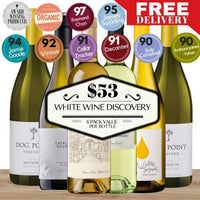
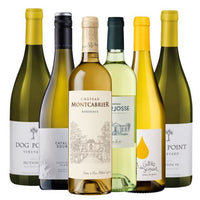
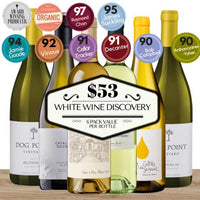
White Wine Discovery
Enjoy a handpicked selection of six premium white wines from some of the world's finest wine regions with the White Wine Discovery 6 Pack. Carefully chosen to showcase diverse flavours and styles, this collection offers something for every palate. Whether you're sharing with friends, stocking your wine rack, or gifting a fellow wine lover, this value 6-pack delivers exceptional quality in every bottle.
1 x Catalina Sounds Sauvignon Blanc 2023 - Marlborough, New Zealand
92/100 Bob Campbell, The Real Review
90/100 Bob Campbell, The Real Review (2022 vintage)
93/100 New Zealand Wine Rater (2022 vintage)
Gold - Asia Wine Challenge (2022 vintage)
Bob Campbell, The Real Review "Tangy, vibrant wine with passionfruit, guava, capsicum and gooseberry flavours. Punchy, textural sauvignon blanc with appealing purity. Good food wine in a mouth-watering, bone dry style."
Bob Campbell, The Real Review "Light, fresh, mouth-watering wine with restrained passionfruit, lemongrass and lime zest. Restrained wine with appealing purity. Made with a light touch. Would be better if the volume was turned up a bit." (2022 vintage)
New Zealand Wine Rater "Restrained, vinous, nose with a herbal lift that keeps you guessing and going back for more. With time in the glass, there are aromas of lemon zest, honeydew melon, nectarine stone, blackcurrant leaf, chervil and Thai basil. An understated, subtle, stylish wine with a delicate, saline, oyster-shell freshness that for all its elegance still shows good concentration and depth." (2022 vintage)
Marlborough based award-winning winery, Catalina Sounds is known for wines that harness the purity and vibrancy of Marlborough’s climate and landscape. The name Catalina Sounds evolved from the majestic Catalina flying boats that played a vital role across the South Pacific during and after World War II.
Marlborough is by far New Zealand's most important wine region. Situated at the north-eastern tip of the South Island, this dry, sunny region produces around three-quarters of all New Zealand wine. It is particularly famous for its pungent, zesty Sauvignon Blanc - widely considered by critics to be the best Sauvignon currently produced anywhere on the planet. Commercial-scale viticulture began in Marlborough in the 1970s – it conquered the world within 25 years!
The Sauvignon Blanc taste is one of the most identifiable in the world of white wines for a few reasons. First, it always has crisp, high acidity. Second, it has a chemical compound called pyrazine which gives grassy, herbal or bell pepper flavors. When grown in cooler climates or picked early, the herbaceous green character is most prominent. In warmer climates or allowed to hang longer on the vine, the pyrazine character diminishes in favor of riper fruit flavors ranging from grapefruit, to passion fruit and guava.
2 x Dog Point Section 94 Barrel Aged Sauvignon Blanc 2017 - Marlborough, New Zealand
97/100 New Zealand Wine Rater
96/100 James Suckling
96/100 Falstaff
95/100 Bob Campbell, The Real Review
Bronze - Wine Enthusiast
Organic
New Zealand Wine Rater "An exceptionally intense, pervasive, complex nose that's certain to elicit a 'wow' from those not familiar with this compelling style of wine. There's an array of appealing aromas including grapefruit rind, desiccated lemon, ashed chevre and nutty, peppery notes from lees contact. A rich, powerful, impressively textural wine with savoury lees and smoky barrel notes and a haunting, positively phenolic 'gin n tonic' finish. It is incredibly fresh for its' age and still has a long life ahead. Amongst the very finest NZ Sauvignons we've ever tried."
James Suckling "This is a very tight, complex and concentrated sauvignon with flint, grilled-lemon and struck-match aromas, as well as passion-fruit pastry. The palate has a smooth textural build with pastry-like texture and flavors of peaches, lemons and mangoes that hold long."
Falstaff "Pale golden yellow, silver glints. Inviting flinty nuances, underpinned by smoky-nutty tones, white fruit, and a delicate touch of lychee. An attractive bouquet. Firm, graceful, racy structure, enhanced by lovely citrus nuances, and a salty finish, with soft reverberations of hazelnuts. Invigorating!"
Bob Campbell, The Real Review "Oak-aged sauvignon that retains varietal character of lime, grapefruit, green pineapple together with savoury/struck flint and saline/mineral characters. Distinctive and complex wine supported by vibrant acidity."
Decanter "From a single parcel within Dog Point’s vineyards, located at the confluence of the Brancott and Omaka valleys, the vines planted in 1992 on free-draining, silty clay-loam alluvial soils. A warm spring and late summer were followed by cool but good conditions into the autumn, with harvest concluded rapidly to beat heavy rains in mid-April 2017. The wine was fermented and aged in used French oak barrels for 18 months, and bottled without fining. Toasty wood to the fore on the nose, but there’s key lime pie richness and herbal notes of marjoram and bay. Ripe lemon and lime citrus with lightly tropical passion fruit and pineapple, though the fruit is underscored by a distinctly earthy/mushroom creamy character enhancing complexity on mid-palate and finish, which has great length. Best with food such as meaty fish, tuna steak or chicken in a creamy mushroom sauce."
Robert Parker, Wine Advocate "Struck flint and hints of woodsmoke appear on the nose of the 2017 Section 94, a Sauvignon Blanc fermented in barrel with indigenous yeasts. This is a tight, compact vintage for this bottling, with tightly coiled grapefruit flavors partially concealed by notions of fresh greens and crushed stone. It's crisp and medium-bodied, with a citrusy finish. It's a solid effort, but compared to other recent Section 94s, it leaves me wanting more."
Organic wines are made from grapes grown without pesticides, following strict organic standards. Organic wines are produced in vineyards that do not use synthetic chemicals.Certified organic wines have been certified by Biogro New Zealand.
Dog Point is one of New Zealand's most loved wineries formed by famous Cloudy Bay's wineries former viticulturalist and winemaker Ivan Sutherland and James Healy. Some years ago they decided to go out on their own creating Dog Point. Dog Point vineyards are some of the earliest vineyards to be planted in Marlborough and have some of the oldest vines in the region. Dog Point is named for the sheep-herding history of the area.
Organic philosophies drive Dog Point's approach to wine growing and in March 2012, 150 hectares of vineyards were certified organic by BioGro New Zealand, with another 60 hectares certified as C1 (2 years in conversion). A flock of around 2,000 sheep including Romney, Perendale Cross and Merino Wiltshire Cross are grazed in the winter to keep the grass low and fertilise as they go.
After pruning; all the prunings, any grass or cover crops are mulched and added to the compost heap. This is spread under the vines to help conserve moisture and improve soil structure. A mob of 25 steers are also grazed on the property.
The Sauvignon Blanc taste is one of the most identifiable in the world of white wines for a few reasons. First, it always has crisp, high acidity. Second, it has a chemical compound called pyrazine which gives grassy, herbal or bell pepper flavors. When grown in cooler climates or picked early, the herbaceous green character is most prominent. In warmer climates or allowed to hang longer on the vine, the pyrazine character diminishes in favor of riper fruit flavors ranging from grapefruit, to passion fruit and guava.
1 x Chateau Montcabrier Bordeaux Blanc 2022 - Bordeaux, France
82.26/100 Global Wine Medal Rating & Vivino Rating (2019 vintage)
Gold - Gilbert & Gaillard International Challenge 2020 (2019 vintage)
Winemaker "Château Montcabrier Bordeaux Blanc is crafted from a blend of Sauvignon Blanc and Sémillon grapes, grown in the renowned Bordeaux region of France. The vineyards benefit from a temperate maritime climate, which promotes balanced ripening and vibrant acidity. The wine is fermented in stainless steel tanks to preserve its fresh, aromatic profile, highlighting notes of citrus and green apple. This Bordeaux Blanc is intended to be enjoyed young, offering a crisp and refreshing drinking experience with a clean finish, making it an ideal companion for seafood and light dishes."
Château Montcabrier is a family-owned estate in Bordeaux dedicated to producing wines that reflect the character and traditions of the region. The winery combines traditional winemaking techniques with modern vineyard practices to ensure quality and consistency across its range. Its philosophy centers on crafting approachable, well-balanced wines that showcase freshness, elegance, and varietal expression. The estate's Bordeaux Blanc is particularly appreciated for its vibrant fruit profile and refreshing style.
Bordeaux, located in southwestern France, is one of the world's most famous wine-producing regions. Its maritime climate, influenced by the nearby Atlantic Ocean, provides mild temperatures and favorable conditions for growing high-quality grapes. The region's diverse soils, including limestone, clay, and gravel, contribute complexity and distinctive character to its wines. Bordeaux is renowned not only for its prestigious red wines but also for its elegant and expressive dry white wines.
Bordeaux Blanc is traditionally crafted from a blend of Sauvignon Blanc and Sémillon, creating wines that are both fresh and well-rounded. Sauvignon Blanc contributes bright acidity and lively aromas of citrus, tropical fruits, and fresh herbs. Sémillon adds richness, texture, and subtle notes of pear, stone fruit, and honey. Together, these varieties produce a harmonious wine with crisp freshness, balanced structure, and excellent food-pairing versatility.
1 x Chateau Marjosse Pierre Lurton Bordeaux Blanc 2020 - Bordeaux, France
91/100 James Suckling
91/100 Decanter
89-91/100 Robert Parker, The Wine Advocate
Owned by one of the world's most famous winemakers, Pierre Lurton - president of two of Bordeaux's best-known chateaux, the Moët Hennessy Louis Vuitton (LVMH) owned Château Cheval Blanc and Château d’Yquem.
James Suckling "Plenty of sliced-apple, peach and lemon character with a medium body, fresh acidity and a clean, vivid finish. Energetic and ready for the beach!"
Decanter "Well placed and perky fruits, not overly high in acidities but instead given focus by slate texture and a point of bitterness on the finish. Bright fruits keep things mouthwatering. 3% Muscadelle completes the plantings (I don't have the specific 2020 blend). This is an enjoyable Bordeaux Blanc with personality; a successful wine in the category."
Robert Parker, The Wine Advocate "Comes skipping out of the glass with vibrant notes of lime leaves, grapefruit and crushed rocks, giving way to emerging notions of green apples, dill seed, and fresh hay. The medium-bodied palate delivers a great intensity of herbs-laced citrus flavors, supported by a racy backbone and finishing long and chalky."
Château Marjosse is owned by French 'wine royalty', Pierre Lurton - president of two of Bordeaux’s best-known châteaux; the Moët Hennessy Louis Vuitton (LVMH) owned, Château Cheval Blanc and Château d’Yquem, Château Marjosse. Pierre Lurton comes from two of the great Bordeaux families. His father Dominique was the youngest son of the paterfamilias François Lurton; his uncle André Lurton who founded the eponymous wine company; his many cousins run châteaux from Pauillac to Pomerol. His mother is from the famous Lafite family.
The influential Club Enologique asserts that Pierre is the most accomplished wine personality of his famous family. Trained as a doctor but swapping his studies for wine making after four years. At 23 he took over Clos Fourtet in St Emilion, one of the fine Lurton properties, and in 1991 he was appointed head of Château Cheval Blanc (it was bought by Bernard Arnault of LVMH in 1998); in 1999 he took on Château d’Yquem, which had just been added to the Arnault portfolio.
Club Enologique describes Pierre Lurton as having the world’s most corporate wine job. "However he divides his time between two of the world’s most exalted wine properties, but comes down to earth in Entre-deux-Mers, the leafy, unpretentious appellation to the east of Bordeaux at Château Marjosse."
The Château Marjosse estate is located in Entre-deux-Mers, on the right bank of Bordeaux. Initially owned by the wine merchant Bernard Chénier, Château Marjosse was acquired by the Deleuze family, who, in 1990, gave some plots to Pierre Lurton to rent. In 1992, Pierre Lurton, who grew up in Château Reynier, neighbour to this magnificent Chartreuse, moved to a second home in Château Marjosse and, over successive years became the owner of the entire vineyard, as well as the Chartreuse in 2013.
Decanter "Since Lurton bought Château Marjosse in 1994, the estate has improved beyond recognition. Pierre's father, Dominique Lurton, also made over a further 30ha so that, under the Château Marjosse label, Lurton now exploits 42ha of vineyard, six hectares of white and 36ha of Bordeaux red – a total of 300,000 bottles a year. Pierre insists his wine is Bordeaux and not Bordeaux Supérieur because ‘my wine is only supérieur in the bottle’. His objectives are ambitious. As the quality of the terroir with clay-limestone soil is similar to some of the better areas in Saint-Emilion, he hopes to prove that wines from this area can rival those from more prestigious regions."
45% Semillon, 35% Sauvignon-Blanc, 15% Sauvignon Gris, 5% Muscadelle
The Entre-deux-Mers region, nicknamed by wine experts as “Little Tuscany”, is unique and jealously protected by its inhabitants. "There are fifteen appellations that constitute the Entre-deux-Mers. The most well-known of them all, reputed for its dry, lively white wines, is certainly the one which bears the name of this region! The Entre-deux-Mers cultivates a certain speciality in producing white wines, due to its basic geological assets, possessing gravelly-limestone soils, upon which Sémillon, Sauvignon, Muscadelle and even Ugni Blanc grape varieties are planted. But the variety of soils and sub-soils associated with such a complex landscape provides a diversity of terroirs … These are favourable for producing red wines, that are regrettably not sufficiently well-known, but highly prized for the complexity of their aromas, their deep, vivid colour, as well as the concentration and elegance of their tannins." Sommeliers International.
Bordeaux, in the southwest of France, needs little introduction as one of the world's most famous, prestigious and prolific wine regions. Its three trump cards are diversity, quality and quantity. The majority of Bordeaux wines (nearly 90 percent of production volume) are the dry, medium- and full-bodied red Bordeaux Blends that established its reputation. The finest (and most expensive) of these come from the great châteaux of the Haut-Médoc and the Right Bank appellations Saint-Émilion and Pomerol. The legendary reds are complemented by high-quality white wines, both dry styles (particularly from Pessac-Léognan) and the sweet, botrytized nectars of Sauternes.
The Sauvignon Blanc taste is one of the most identifiable in the world of white wines for a few reasons. First, it always has crisp, high acidity. Second, it has a chemical compound called pyrazine which gives grassy, herbal or bell pepper flavors. When grown in cooler climates or picked early, the herbaceous green character is most prominent. In warmer climates or allowed to hang longer on the vine, the pyrazine character diminishes in favor of riper fruit flavors ranging from grapefruit, to passion fruit and guava.
1 x La Goutte du Seigneur Côtes du Rhône Blanc 2022 - Rhone, France
Organic
Winemaker "La Goutte du Seigneur is a divine refreshment, with an aromatic nose of white flowers, a fresh and thirst-quenching palate of orchard fruits. It's the ideal companion for your BBQs and pétanque parties!"
33% Grenache, 33% Bourboulenc, 33% Viognier
Alcohol: 13%
The name of this organic and biodynamically farmed cuvée refers to their family name, translating as "Drop of the Lord".
Bernard Duseigneur "Seizing the opportunity that nature gives us; that is the essence of biodynamics for me"
Bernard Duseigneur, hailing from a lineage of winemakers, assumed control of the family's domaine in 2002 after a stint in investment banking. Returning to his Mediterranean origins, he continued the legacy of his father and brother, ultimately settling in Châteauneuf-du-Pape on the left bank of the Rhône.
In Châteauneuf-du-Pape, the terroir isn't solely defined by iconic orange pebbles; it comprises diverse soils like red clays, limestone, sandstone sands, and loams from the Rhone's banks. Acknowledging that exceptional terroir alone isn't enough for quality wines, Bernard prioritizes soil vitality. His team nurtures a diverse flora and fauna that mobilize trace elements, fostering symbiosis between plant and soil.
Enjoy a handpicked selection of six premium white wines from some of the world's finest wine regions with the White Wine Discovery 6 Pack. Carefully chosen to showcase diverse flavours and styles, this collection offers something for every palate. Whether you're sharing with friends, stocking your wine rack, or gifting a fellow wine lover, this value 6-pack delivers exceptional quality in every bottle.
1 x Catalina Sounds Sauvignon Blanc 2023 - Marlborough, New Zealand
92/100 Bob Campbell, The Real Review
90/100 Bob Campbell, The Real Review (2022 vintage)
93/100 New Zealand Wine Rater (2022 vintage)
Gold - Asia Wine Challenge (2022 vintage)
Bob Campbell, The Real Review "Tangy, vibrant wine with passionfruit, guava, capsicum and gooseberry flavours. Punchy, textural sauvignon blanc with appealing purity. Good food wine in a mouth-watering, bone dry style."
Bob Campbell, The Real Review "Light, fresh, mouth-watering wine with restrained passionfruit, lemongrass and lime zest. Restrained wine with appealing purity. Made with a light touch. Would be better if the volume was turned up a bit." (2022 vintage)
New Zealand Wine Rater "Restrained, vinous, nose with a herbal lift that keeps you guessing and going back for more. With time in the glass, there are aromas of lemon zest, honeydew melon, nectarine stone, blackcurrant leaf, chervil and Thai basil. An understated, subtle, stylish wine with a delicate, saline, oyster-shell freshness that for all its elegance still shows good concentration and depth." (2022 vintage)
Marlborough based award-winning winery, Catalina Sounds is known for wines that harness the purity and vibrancy of Marlborough’s climate and landscape. The name Catalina Sounds evolved from the majestic Catalina flying boats that played a vital role across the South Pacific during and after World War II.
Marlborough is by far New Zealand's most important wine region. Situated at the north-eastern tip of the South Island, this dry, sunny region produces around three-quarters of all New Zealand wine. It is particularly famous for its pungent, zesty Sauvignon Blanc - widely considered by critics to be the best Sauvignon currently produced anywhere on the planet. Commercial-scale viticulture began in Marlborough in the 1970s – it conquered the world within 25 years!
The Sauvignon Blanc taste is one of the most identifiable in the world of white wines for a few reasons. First, it always has crisp, high acidity. Second, it has a chemical compound called pyrazine which gives grassy, herbal or bell pepper flavors. When grown in cooler climates or picked early, the herbaceous green character is most prominent. In warmer climates or allowed to hang longer on the vine, the pyrazine character diminishes in favor of riper fruit flavors ranging from grapefruit, to passion fruit and guava.
2 x Dog Point Section 94 Barrel Aged Sauvignon Blanc 2017 - Marlborough, New Zealand
97/100 New Zealand Wine Rater
96/100 James Suckling
96/100 Falstaff
95/100 Bob Campbell, The Real Review
Bronze - Wine Enthusiast
Organic
New Zealand Wine Rater "An exceptionally intense, pervasive, complex nose that's certain to elicit a 'wow' from those not familiar with this compelling style of wine. There's an array of appealing aromas including grapefruit rind, desiccated lemon, ashed chevre and nutty, peppery notes from lees contact. A rich, powerful, impressively textural wine with savoury lees and smoky barrel notes and a haunting, positively phenolic 'gin n tonic' finish. It is incredibly fresh for its' age and still has a long life ahead. Amongst the very finest NZ Sauvignons we've ever tried."
James Suckling "This is a very tight, complex and concentrated sauvignon with flint, grilled-lemon and struck-match aromas, as well as passion-fruit pastry. The palate has a smooth textural build with pastry-like texture and flavors of peaches, lemons and mangoes that hold long."
Falstaff "Pale golden yellow, silver glints. Inviting flinty nuances, underpinned by smoky-nutty tones, white fruit, and a delicate touch of lychee. An attractive bouquet. Firm, graceful, racy structure, enhanced by lovely citrus nuances, and a salty finish, with soft reverberations of hazelnuts. Invigorating!"
Bob Campbell, The Real Review "Oak-aged sauvignon that retains varietal character of lime, grapefruit, green pineapple together with savoury/struck flint and saline/mineral characters. Distinctive and complex wine supported by vibrant acidity."
Decanter "From a single parcel within Dog Point’s vineyards, located at the confluence of the Brancott and Omaka valleys, the vines planted in 1992 on free-draining, silty clay-loam alluvial soils. A warm spring and late summer were followed by cool but good conditions into the autumn, with harvest concluded rapidly to beat heavy rains in mid-April 2017. The wine was fermented and aged in used French oak barrels for 18 months, and bottled without fining. Toasty wood to the fore on the nose, but there’s key lime pie richness and herbal notes of marjoram and bay. Ripe lemon and lime citrus with lightly tropical passion fruit and pineapple, though the fruit is underscored by a distinctly earthy/mushroom creamy character enhancing complexity on mid-palate and finish, which has great length. Best with food such as meaty fish, tuna steak or chicken in a creamy mushroom sauce."
Robert Parker, Wine Advocate "Struck flint and hints of woodsmoke appear on the nose of the 2017 Section 94, a Sauvignon Blanc fermented in barrel with indigenous yeasts. This is a tight, compact vintage for this bottling, with tightly coiled grapefruit flavors partially concealed by notions of fresh greens and crushed stone. It's crisp and medium-bodied, with a citrusy finish. It's a solid effort, but compared to other recent Section 94s, it leaves me wanting more."
Organic wines are made from grapes grown without pesticides, following strict organic standards. Organic wines are produced in vineyards that do not use synthetic chemicals.Certified organic wines have been certified by Biogro New Zealand.
Dog Point is one of New Zealand's most loved wineries formed by famous Cloudy Bay's wineries former viticulturalist and winemaker Ivan Sutherland and James Healy. Some years ago they decided to go out on their own creating Dog Point. Dog Point vineyards are some of the earliest vineyards to be planted in Marlborough and have some of the oldest vines in the region. Dog Point is named for the sheep-herding history of the area.
Organic philosophies drive Dog Point's approach to wine growing and in March 2012, 150 hectares of vineyards were certified organic by BioGro New Zealand, with another 60 hectares certified as C1 (2 years in conversion). A flock of around 2,000 sheep including Romney, Perendale Cross and Merino Wiltshire Cross are grazed in the winter to keep the grass low and fertilise as they go.
After pruning; all the prunings, any grass or cover crops are mulched and added to the compost heap. This is spread under the vines to help conserve moisture and improve soil structure. A mob of 25 steers are also grazed on the property.
The Sauvignon Blanc taste is one of the most identifiable in the world of white wines for a few reasons. First, it always has crisp, high acidity. Second, it has a chemical compound called pyrazine which gives grassy, herbal or bell pepper flavors. When grown in cooler climates or picked early, the herbaceous green character is most prominent. In warmer climates or allowed to hang longer on the vine, the pyrazine character diminishes in favor of riper fruit flavors ranging from grapefruit, to passion fruit and guava.
1 x Chateau Montcabrier Bordeaux Blanc 2022 - Bordeaux, France
82.26/100 Global Wine Medal Rating & Vivino Rating (2019 vintage)
Gold - Gilbert & Gaillard International Challenge 2020 (2019 vintage)
Winemaker "Château Montcabrier Bordeaux Blanc is crafted from a blend of Sauvignon Blanc and Sémillon grapes, grown in the renowned Bordeaux region of France. The vineyards benefit from a temperate maritime climate, which promotes balanced ripening and vibrant acidity. The wine is fermented in stainless steel tanks to preserve its fresh, aromatic profile, highlighting notes of citrus and green apple. This Bordeaux Blanc is intended to be enjoyed young, offering a crisp and refreshing drinking experience with a clean finish, making it an ideal companion for seafood and light dishes."
Château Montcabrier is a family-owned estate in Bordeaux dedicated to producing wines that reflect the character and traditions of the region. The winery combines traditional winemaking techniques with modern vineyard practices to ensure quality and consistency across its range. Its philosophy centers on crafting approachable, well-balanced wines that showcase freshness, elegance, and varietal expression. The estate's Bordeaux Blanc is particularly appreciated for its vibrant fruit profile and refreshing style.
Bordeaux, located in southwestern France, is one of the world's most famous wine-producing regions. Its maritime climate, influenced by the nearby Atlantic Ocean, provides mild temperatures and favorable conditions for growing high-quality grapes. The region's diverse soils, including limestone, clay, and gravel, contribute complexity and distinctive character to its wines. Bordeaux is renowned not only for its prestigious red wines but also for its elegant and expressive dry white wines.
Bordeaux Blanc is traditionally crafted from a blend of Sauvignon Blanc and Sémillon, creating wines that are both fresh and well-rounded. Sauvignon Blanc contributes bright acidity and lively aromas of citrus, tropical fruits, and fresh herbs. Sémillon adds richness, texture, and subtle notes of pear, stone fruit, and honey. Together, these varieties produce a harmonious wine with crisp freshness, balanced structure, and excellent food-pairing versatility.
1 x Chateau Marjosse Pierre Lurton Bordeaux Blanc 2020 - Bordeaux, France
91/100 James Suckling
91/100 Decanter
89-91/100 Robert Parker, The Wine Advocate
Owned by one of the world's most famous winemakers, Pierre Lurton - president of two of Bordeaux's best-known chateaux, the Moët Hennessy Louis Vuitton (LVMH) owned Château Cheval Blanc and Château d’Yquem.
James Suckling "Plenty of sliced-apple, peach and lemon character with a medium body, fresh acidity and a clean, vivid finish. Energetic and ready for the beach!"
Decanter "Well placed and perky fruits, not overly high in acidities but instead given focus by slate texture and a point of bitterness on the finish. Bright fruits keep things mouthwatering. 3% Muscadelle completes the plantings (I don't have the specific 2020 blend). This is an enjoyable Bordeaux Blanc with personality; a successful wine in the category."
Robert Parker, The Wine Advocate "Comes skipping out of the glass with vibrant notes of lime leaves, grapefruit and crushed rocks, giving way to emerging notions of green apples, dill seed, and fresh hay. The medium-bodied palate delivers a great intensity of herbs-laced citrus flavors, supported by a racy backbone and finishing long and chalky."
Château Marjosse is owned by French 'wine royalty', Pierre Lurton - president of two of Bordeaux’s best-known châteaux; the Moët Hennessy Louis Vuitton (LVMH) owned, Château Cheval Blanc and Château d’Yquem, Château Marjosse. Pierre Lurton comes from two of the great Bordeaux families. His father Dominique was the youngest son of the paterfamilias François Lurton; his uncle André Lurton who founded the eponymous wine company; his many cousins run châteaux from Pauillac to Pomerol. His mother is from the famous Lafite family.
The influential Club Enologique asserts that Pierre is the most accomplished wine personality of his famous family. Trained as a doctor but swapping his studies for wine making after four years. At 23 he took over Clos Fourtet in St Emilion, one of the fine Lurton properties, and in 1991 he was appointed head of Château Cheval Blanc (it was bought by Bernard Arnault of LVMH in 1998); in 1999 he took on Château d’Yquem, which had just been added to the Arnault portfolio.
Club Enologique describes Pierre Lurton as having the world’s most corporate wine job. "However he divides his time between two of the world’s most exalted wine properties, but comes down to earth in Entre-deux-Mers, the leafy, unpretentious appellation to the east of Bordeaux at Château Marjosse."
The Château Marjosse estate is located in Entre-deux-Mers, on the right bank of Bordeaux. Initially owned by the wine merchant Bernard Chénier, Château Marjosse was acquired by the Deleuze family, who, in 1990, gave some plots to Pierre Lurton to rent. In 1992, Pierre Lurton, who grew up in Château Reynier, neighbour to this magnificent Chartreuse, moved to a second home in Château Marjosse and, over successive years became the owner of the entire vineyard, as well as the Chartreuse in 2013.
Decanter "Since Lurton bought Château Marjosse in 1994, the estate has improved beyond recognition. Pierre's father, Dominique Lurton, also made over a further 30ha so that, under the Château Marjosse label, Lurton now exploits 42ha of vineyard, six hectares of white and 36ha of Bordeaux red – a total of 300,000 bottles a year. Pierre insists his wine is Bordeaux and not Bordeaux Supérieur because ‘my wine is only supérieur in the bottle’. His objectives are ambitious. As the quality of the terroir with clay-limestone soil is similar to some of the better areas in Saint-Emilion, he hopes to prove that wines from this area can rival those from more prestigious regions."
45% Semillon, 35% Sauvignon-Blanc, 15% Sauvignon Gris, 5% Muscadelle
The Entre-deux-Mers region, nicknamed by wine experts as “Little Tuscany”, is unique and jealously protected by its inhabitants. "There are fifteen appellations that constitute the Entre-deux-Mers. The most well-known of them all, reputed for its dry, lively white wines, is certainly the one which bears the name of this region! The Entre-deux-Mers cultivates a certain speciality in producing white wines, due to its basic geological assets, possessing gravelly-limestone soils, upon which Sémillon, Sauvignon, Muscadelle and even Ugni Blanc grape varieties are planted. But the variety of soils and sub-soils associated with such a complex landscape provides a diversity of terroirs … These are favourable for producing red wines, that are regrettably not sufficiently well-known, but highly prized for the complexity of their aromas, their deep, vivid colour, as well as the concentration and elegance of their tannins." Sommeliers International.
Bordeaux, in the southwest of France, needs little introduction as one of the world's most famous, prestigious and prolific wine regions. Its three trump cards are diversity, quality and quantity. The majority of Bordeaux wines (nearly 90 percent of production volume) are the dry, medium- and full-bodied red Bordeaux Blends that established its reputation. The finest (and most expensive) of these come from the great châteaux of the Haut-Médoc and the Right Bank appellations Saint-Émilion and Pomerol. The legendary reds are complemented by high-quality white wines, both dry styles (particularly from Pessac-Léognan) and the sweet, botrytized nectars of Sauternes.
The Sauvignon Blanc taste is one of the most identifiable in the world of white wines for a few reasons. First, it always has crisp, high acidity. Second, it has a chemical compound called pyrazine which gives grassy, herbal or bell pepper flavors. When grown in cooler climates or picked early, the herbaceous green character is most prominent. In warmer climates or allowed to hang longer on the vine, the pyrazine character diminishes in favor of riper fruit flavors ranging from grapefruit, to passion fruit and guava.
1 x La Goutte du Seigneur Côtes du Rhône Blanc 2022 - Rhone, France
Organic
Winemaker "La Goutte du Seigneur is a divine refreshment, with an aromatic nose of white flowers, a fresh and thirst-quenching palate of orchard fruits. It's the ideal companion for your BBQs and pétanque parties!"
33% Grenache, 33% Bourboulenc, 33% Viognier
Alcohol: 13%
The name of this organic and biodynamically farmed cuvée refers to their family name, translating as "Drop of the Lord".
Bernard Duseigneur "Seizing the opportunity that nature gives us; that is the essence of biodynamics for me"
Bernard Duseigneur, hailing from a lineage of winemakers, assumed control of the family's domaine in 2002 after a stint in investment banking. Returning to his Mediterranean origins, he continued the legacy of his father and brother, ultimately settling in Châteauneuf-du-Pape on the left bank of the Rhône.
In Châteauneuf-du-Pape, the terroir isn't solely defined by iconic orange pebbles; it comprises diverse soils like red clays, limestone, sandstone sands, and loams from the Rhone's banks. Acknowledging that exceptional terroir alone isn't enough for quality wines, Bernard prioritizes soil vitality. His team nurtures a diverse flora and fauna that mobilize trace elements, fostering symbiosis between plant and soil.