


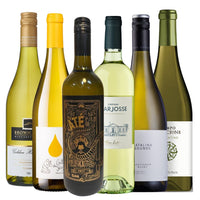
Pure & Elegant – White Wine Discovery
Refreshing charm of premium white wines with the Pure & Elegant – White Wine Discovery collection. Carefully curated to showcase vibrant fruit flavours, crisp acidity, and refined regional character, this selection is perfect for exploring a variety of white wine styles. Whether you're entertaining, pairing with seafood, or simply enjoying a relaxing glass, this collection offers exceptional quality and elegance in every bottle.
1 x Ate Chardonnay 2023 - South East Australia, Australia
Winemaker "Made from South Eastern Australia Chardonnay grapes, showcases the winery's commitment to retaining freshness and acidity. Harvested in the cool of the night, this wine offers a base of cool fermentation that results in a beautifully balanced and expressive Chardonnay."
Até Winery produces meticulously crafted wines from some of the premium wine growing areas of Victoria and South Australia. These wines embody the mischievous and playful nature of the Greek goddess Até. With a focus on fruit-forward profiles and generous flavours, each wine displays the hallmarks of its region and is a testament to the artistry and passion of the winemaker.
Their range includes the Até Sparkling, Até Pinot Grigio, Até Chardonnay, and Até Shiraz, each offering unique and delightful flavours that fully express the region from which they are from. There are the bright lemony notes of the Sparkling, a shining example of the winery's dedication to quality and flavour, the zesty freshness of the Pinot Grigio, and the expressive character of the Chardonnay made from South Eastern Australian grapes. The Shiraz is a deep ruby color and purple hue, with aromas and flavors of red and dark plum, boysenberry, smoky oak spices, and hints of black pepper.
All these wines exemplify the winery's commitment to quality and flavour.
Chardonnay is one of the world’s most popular grapes, Chardonnay is made in a wide range of styles from lean, to rich, creamy white wines aged in oak. Bolder, richer, full-bodied and buttery Chardonnays are made using oak and are produced in California, Burgundy, and Australia. Unoaked chardonnays such as Chablis and those produced in Chile, New Zealand, and other parts of France are leaner and often crisp and mineraly, with delicate flavors. By law, if a label says “Chablis,” it must be Chardonnay.
1 x Brown Hill Golden Horseshoe Reserve Chardonnay 2019 ~ Margaret River, Western Australia
95/100 Erin Larkin, Halliday Wine Companion
92/100 Ray Jordan, WA Wine Guide
Bronze - Huon Hooke, The Real Review
Silver - Margaret River Wine Show 2020
‘SMALL PRODUCER OF THE YEAR’ ~ The West Australian Wine Guide 2010
‘SMALL PRODUCER OF THE YEAR’ ~ The West Australian Wine , Guide 2009
Erin Larkin, Halliday Wine Companion "Hand picked, whole-bunch pressed, fermented in a combination of seasoned and new French oak. Toasty, chewy and packed with layers of flavour and texture. The saline acid ties it all to a post, the concentrated fruit forms a deep pool of flavour on the tongue. There's a lot to ponder, a lot to like, and thankfully, a whole bottle to drink. Get to it."
Huon Hooke, The Real Review "Very light-straw colour. The aroma is reserved and a bit shy, with a faint floral overtone, while the palate is light but reasonably intense, straightforward and tickled up with a trace of sweetness. A pleasant wine."
The Western Australian Wine Guide 2018 "Brown Hill Estate is small family-run southern Margaret River producer has gone from strength to strength with a range of exceptional quality and value-for-money wines. The vines are all dry grown and on quite harsh gravelly soils, resulting in small yields. All grapes are hand-picked. The reds are put into a high percentage of new American and French oak. Great value and super wines."
Brown Hill Estate is a family run, multi-award winning Margaret River winery focussed on single vineyards. It utilizes traditional methods of handpicking and hand sorting to get the best quality from its grapes, and French coopered barrels in production.
Margaret River is one of the best-known wine regions in Australia, recognized internationally for the quality of its wines and the natural beauty of the region. Although originally renowned for its unusually refined Cabernet Sauvignon and intensely citrusy chardonnay varieties, the region now produces Semillon Sauvignon Blanc blends and Shiraz.
Located in the south-western corner of Western Australia, it is famous for having a more 'European' wine style than its counterparts across Australia, owing to the regions temperate, coastal location which is very similar to that of Bordeaux.
Chardonnay is one of the world’s most popular grapes, Chardonnay is made in a wide range of styles from lean, to rich, creamy white wines aged in oak. Bolder, richer, full-bodied and buttery Chardonnays are made using oak and are produced in California, Burgundy, and Australia. Unoaked chardonnays such as Chablis and those produced in Chile, New Zealand, and other parts of France are leaner and often crisp and mineraly, with delicate flavors. By law, if a label says “Chablis,” it must be Chardonnay.
1 x Campo Maccione Vermentino 2023 - Tuscany, Italy
90/100 James Suckling
90/100 Wine Enthusiast
Bronze - Vinum
Bronze - Raffaele Vecchione - Wines Critic
Gold - Mundus Vini
Organic - currently undergoing certification
James Suckling "A delicious, fruity and subtle vermentino with aromas of pears, ripe peaches and wild herbs on the nose, following through to a medium body with fresh acidity. Seductive and minerally at the center, with a delicious core of crunchy fruit in the crisp finish"
Wine Enthusiast "The nose is fresh and clean, with aromas of lemon, lime, ocean air and bike tire. On the palate, a backbone of hazelnuts and almonds creates a savory feel, although green and yellow apple flavors and more citrus preserve a piercing quality. Tannins are present, even within a river of acid."
Raffaele Vecchione - Wines Critic "In its sensory profile, it reveals notes of magnolia, gardenia, jasmine, acacia, lemon peel, and white pepper. Full-bodied, with a "fat" mouthfeel, it finishes warm and enveloping. Sweet on the finish."
100% Vermentino
Alcohol: 13%
Rocca delle Macìe was established in 1973, when film producer Italo Zingarelli – of Ettore Scola’s “We All Loved Each Other So Much” fame, and also the wildly popular series of films featuring comedy duo Bud Spencer and Terence Hill (including “They Call Me Trinity” and “Trinity Is Still My Name”) – decided to realize his lifelong dream by acquiring the “Le Macìe” estate – extending across 93 hectares (230 acres) in all, of which only two were under vine – in order to create a winery in the heart of the Chianti Classico zone.
Enjoy this wine made on the Zingarelli family’s Maremma estates. Morellino di Scansano takes center-stage but has been complemented over the years by white and rosé wines bearing the recently created Maremma DOC denomination, along with Typical Geographical Indication (IGT) wines in a more modern style that nevertheless respects the Tuscan tradition.
Vermentino (“vur-men-teeno”) is a light-bodied white wine that grows mostly in Italy on the island of Sardinia. What’s exciting about Vermentino is it can be deliciously complex in taste in similar style to Sauvignon Blanc; One style is richer and creamier and the other is lighter, more floral and zestier. Because Vermentino is so unknown, you can find high quality wines for a great value. Wines with similar body and taste profile include Albariño, Grüner Veltliner, Sauvignon Blanc, Sémillon, Soave and Verdejo.
Despite the typical light-bodied character of Vermentino, it’s actually quite complex to taste. A glass of classic Sardinia Vermentino will offer up lively aromas of pear, white peach, lime and pink grapefruit with subtle notes of crushed rocks and citrus zest. On the palate, Vermentino is almost always dry and somewhat oily with flavors of grapefruit and citrus, with a crushed rocky minerality and saltiness. On the finish, it can be a bit snappy with bitterness similar to the taste of grapefruit pith or, if it’s on the riper side, fresh almond.
In Provence, Vermentino is called Rolle (“roll”). It’s the secret ingredient to the region’s top-rated Rosé.
1 x Chateau Marjosse Pierre Lurton Bordeaux Blanc 2020 - Bordeaux, France
91/100 James Suckling
91/100 Decanter
89-91/100 Robert Parker, The Wine Advocate
88-90/100 Anthocyanes - Yohan Castaing
15.5/20 Vinum Wine Magazine
14.5/20 La Revue du Vin de France
Owned by one of the world's most famous winemakers, Pierre Lurton - president of two of Bordeaux's best-known chateaux, the Moët Hennessy Louis Vuitton (LVMH) owned Château Cheval Blanc and Château d’Yquem.
James Suckling "Plenty of sliced-apple, peach and lemon character with a medium body, fresh acidity and a clean, vivid finish. Energetic and ready for the beach!"
Decanter "Well placed and perky fruits, not overly high in acidities but instead given focus by slate texture and a point of bitterness on the finish. Bright fruits keep things mouthwatering. 3% Muscadelle completes the plantings (I don't have the specific 2020 blend). This is an enjoyable Bordeaux Blanc with personality; a successful wine in the category."
Robert Parker, The Wine Advocate "Comes skipping out of the glass with vibrant notes of lime leaves, grapefruit and crushed rocks, giving way to emerging notions of green apples, dill seed, and fresh hay. The medium-bodied palate delivers a great intensity of herbs-laced citrus flavors, supported by a racy backbone and finishing long and chalky."
Vinum Wine Magazine "Particularly refreshing and drinkable with its notes of acacia and mint, its slim but well-structured build, the noticeable minerality. Enjoy young..."
Château Marjosse is owned by French 'wine royalty', Pierre Lurton - president of two of Bordeaux’s best-known châteaux; the Moët Hennessy Louis Vuitton (LVMH) owned, Château Cheval Blanc and Château d’Yquem, Château Marjosse. Pierre Lurton comes from two of the great Bordeaux families. His father Dominique was the youngest son of the paterfamilias François Lurton; his uncle André Lurton who founded the eponymous wine company; his many cousins run châteaux from Pauillac to Pomerol. His mother is from the famous Lafite family.
The influential Club Enologique asserts that Pierre is the most accomplished wine personality of his famous family. Trained as a doctor but swapping his studies for wine making after four years. At 23 he took over Clos Fourtet in St Emilion, one of the fine Lurton properties, and in 1991 he was appointed head of Château Cheval Blanc (it was bought by Bernard Arnault of LVMH in 1998); in 1999 he took on Château d’Yquem, which had just been added to the Arnault portfolio.
Club Enologique describes Pierre Lurton as having the world’s most corporate wine job. "However he divides his time between two of the world’s most exalted wine properties, but comes down to earth in Entre-deux-Mers, the leafy, unpretentious appellation to the east of Bordeaux at Château Marjosse."
The Château Marjosse estate is located in Entre-deux-Mers, on the right bank of Bordeaux. Initially owned by the wine merchant Bernard Chénier, Château Marjosse was acquired by the Deleuze family, who, in 1990, gave some plots to Pierre Lurton to rent. In 1992, Pierre Lurton, who grew up in Château Reynier, neighbour to this magnificent Chartreuse, moved to a second home in Château Marjosse and, over successive years became the owner of the entire vineyard, as well as the Chartreuse in 2013.
Sommeliers International "At Château Marjosse the land possesses yet another specific feature, known locally as “la Boulbène”, a silty-clayey texture that has developed on ancient alluvions. The fertility of these soils no longer needs to be proved, because, by chance, they are also found in Saint-Emilion, a terroir that is extremely familiar to the man who manages “Cheval Blanc” …. Pierre Lurton. Assisted in this transformation by Consultant-Oenologist Pascal Poussevin, whose recommendations range from vine growing to wine-making, Pierre Lurton’s estate has now reached its cruising speed … Beyond the fabulous adventures he experiences in his role as manager of Châteaux d’Yquem, Cheval Blanc, as well as estates in South Africa, Latin America and in Australia … it is undoubtedly with “the salt of this land here in the Entre-deux-Mers” that his years of quest for perfection will be revealed. It is clear that this region needs winegrowers of such calibre, those who possess a sixth sense and, using techniques that almost resemble intentional alchemy, transform the grapes they touch into wines that exude the unique character of a specific area."
45% Semillon, 35% Sauvignon-Blanc, 15% Sauvignon Gris, 5% Muscadelle
The Entre-deux-Mers region, nicknamed by wine experts as “Little Tuscany”, is unique and jealously protected by its inhabitants. "There are fifteen appellations that constitute the Entre-deux-Mers. The most well-known of them all, reputed for its dry, lively white wines, is certainly the one which bears the name of this region! The Entre-deux-Mers cultivates a certain speciality in producing white wines, due to its basic geological assets, possessing gravelly-limestone soils, upon which Sémillon, Sauvignon, Muscadelle and even Ugni Blanc grape varieties are planted. But the variety of soils and sub-soils associated with such a complex landscape provides a diversity of terroirs … These are favourable for producing red wines, that are regrettably not sufficiently well-known, but highly prized for the complexity of their aromas, their deep, vivid colour, as well as the concentration and elegance of their tannins." Sommeliers International.
Bordeaux, in the southwest of France, needs little introduction as one of the world's most famous, prestigious and prolific wine regions. Its three trump cards are diversity, quality and quantity. The majority of Bordeaux wines (nearly 90 percent of production volume) are the dry, medium- and full-bodied red Bordeaux Blends that established its reputation. The finest (and most expensive) of these come from the great châteaux of the Haut-Médoc and the Right Bank appellations Saint-Émilion and Pomerol. The legendary reds are complemented by high-quality white wines, both dry styles (particularly from Pessac-Léognan) and the sweet, botrytized nectars of Sauternes.
The Sauvignon Blanc taste is one of the most identifiable in the world of white wines for a few reasons. First, it always has crisp, high acidity. Second, it has a chemical compound called pyrazine which gives grassy, herbal or bell pepper flavors. When grown in cooler climates or picked early, the herbaceous green character is most prominent. In warmer climates or allowed to hang longer on the vine, the pyrazine character diminishes in favor of riper fruit flavors ranging from grapefruit, to passion fruit and guava.
1 x La Goutte du Seigneur Côtes du Rhône Blanc 2022 - Rhone, France
Organic
Winemaker "La Goutte du Seigneur is a divine refreshment, with an aromatic nose of white flowers, a fresh and thirst-quenching palate of orchard fruits. It's the ideal companion for your BBQs and pétanque parties!"
33% Grenache, 33% Bourboulenc, 33% Viognier
Alcohol: 13%
The name of this organic and biodynamically farmed cuvée refers to their family name, translating as "Drop of the Lord".
Bernard Duseigneur "Seizing the opportunity that nature gives us; that is the essence of biodynamics for me"
Bernard Duseigneur, hailing from a lineage of winemakers, assumed control of the family's domaine in 2002 after a stint in investment banking. Returning to his Mediterranean origins, he continued the legacy of his father and brother, ultimately settling in Châteauneuf-du-Pape on the left bank of the Rhône.
In Châteauneuf-du-Pape, the terroir isn't solely defined by iconic orange pebbles; it comprises diverse soils like red clays, limestone, sandstone sands, and loams from the Rhone's banks. Acknowledging that exceptional terroir alone isn't enough for quality wines, Bernard prioritizes soil vitality. His team nurtures a diverse flora and fauna that mobilize trace elements, fostering symbiosis between plant and soil.
1 x Catalina Sounds Sauvignon Blanc 2024 - Marlborough, New Zealand
92/100 Bob Campbell, The Real Review
93/100 New Zealand Wine Rater (2022 vintage)
Gold - Asia Wine Challenge (2022 vintage)
Bob Campbell, The Real Review "Tangy, vibrant wine with passionfruit, guava, capsicum and gooseberry flavours. Punchy, textural sauvignon blanc with appealing purity. Good food wine in a mouth-watering, bone dry style."
Bob Campbell, The Real Review "Light, fresh, mouth-watering wine with restrained passionfruit, lemongrass and lime zest. Restrained wine with appealing purity. Made with a light touch. Would be better if the volume was turned up a bit." (2022 vintage)
New Zealand Wine Rater "Restrained, vinous, nose with a herbal lift that keeps you guessing and going back for more. With time in the glass, there are aromas of lemon zest, honeydew melon, nectarine stone, blackcurrant leaf, chervil and Thai basil. An understated, subtle, stylish wine with a delicate, saline, oyster-shell freshness that for all its elegance still shows good concentration and depth." (2022 vintage)
Wine Spectator "This juicy and succulent white opens on a fresh note of lemon verbena and lemongrass, with wonderful purity to the pear, Honeycrisp apple and lemon curd flavors, backed by a lingering note of fresh yuzu juice." (2021 vintage)
Marlborough based award-winning winery, Catalina Sounds is known for wines that harness the purity and vibrancy of Marlborough’s climate and landscape. The name Catalina Sounds evolved from the majestic Catalina flying boats that played a vital role across the South Pacific during and after World War II.
Marlborough is by far New Zealand's most important wine region. Situated at the north-eastern tip of the South Island, this dry, sunny region produces around three-quarters of all New Zealand wine. It is particularly famous for its pungent, zesty Sauvignon Blanc - widely considered by critics to be the best Sauvignon currently produced anywhere on the planet. Commercial-scale viticulture began in Marlborough in the 1970s – it conquered the world within 25 years!
The Sauvignon Blanc taste is one of the most identifiable in the world of white wines for a few reasons. First, it always has crisp, high acidity. Second, it has a chemical compound called pyrazine which gives grassy, herbal or bell pepper flavors. When grown in cooler climates or picked early, the herbaceous green character is most prominent. In warmer climates or allowed to hang longer on the vine, the pyrazine character diminishes in favor of riper fruit flavors ranging from grapefruit, to passion fruit and guava.
Refreshing charm of premium white wines with the Pure & Elegant – White Wine Discovery collection. Carefully curated to showcase vibrant fruit flavours, crisp acidity, and refined regional character, this selection is perfect for exploring a variety of white wine styles. Whether you're entertaining, pairing with seafood, or simply enjoying a relaxing glass, this collection offers exceptional quality and elegance in every bottle.
1 x Ate Chardonnay 2023 - South East Australia, Australia
Winemaker "Made from South Eastern Australia Chardonnay grapes, showcases the winery's commitment to retaining freshness and acidity. Harvested in the cool of the night, this wine offers a base of cool fermentation that results in a beautifully balanced and expressive Chardonnay."
Até Winery produces meticulously crafted wines from some of the premium wine growing areas of Victoria and South Australia. These wines embody the mischievous and playful nature of the Greek goddess Até. With a focus on fruit-forward profiles and generous flavours, each wine displays the hallmarks of its region and is a testament to the artistry and passion of the winemaker.
Their range includes the Até Sparkling, Até Pinot Grigio, Até Chardonnay, and Até Shiraz, each offering unique and delightful flavours that fully express the region from which they are from. There are the bright lemony notes of the Sparkling, a shining example of the winery's dedication to quality and flavour, the zesty freshness of the Pinot Grigio, and the expressive character of the Chardonnay made from South Eastern Australian grapes. The Shiraz is a deep ruby color and purple hue, with aromas and flavors of red and dark plum, boysenberry, smoky oak spices, and hints of black pepper.
All these wines exemplify the winery's commitment to quality and flavour.
Chardonnay is one of the world’s most popular grapes, Chardonnay is made in a wide range of styles from lean, to rich, creamy white wines aged in oak. Bolder, richer, full-bodied and buttery Chardonnays are made using oak and are produced in California, Burgundy, and Australia. Unoaked chardonnays such as Chablis and those produced in Chile, New Zealand, and other parts of France are leaner and often crisp and mineraly, with delicate flavors. By law, if a label says “Chablis,” it must be Chardonnay.
1 x Brown Hill Golden Horseshoe Reserve Chardonnay 2019 ~ Margaret River, Western Australia
95/100 Erin Larkin, Halliday Wine Companion
92/100 Ray Jordan, WA Wine Guide
Bronze - Huon Hooke, The Real Review
Silver - Margaret River Wine Show 2020
‘SMALL PRODUCER OF THE YEAR’ ~ The West Australian Wine Guide 2010
‘SMALL PRODUCER OF THE YEAR’ ~ The West Australian Wine , Guide 2009
Erin Larkin, Halliday Wine Companion "Hand picked, whole-bunch pressed, fermented in a combination of seasoned and new French oak. Toasty, chewy and packed with layers of flavour and texture. The saline acid ties it all to a post, the concentrated fruit forms a deep pool of flavour on the tongue. There's a lot to ponder, a lot to like, and thankfully, a whole bottle to drink. Get to it."
Huon Hooke, The Real Review "Very light-straw colour. The aroma is reserved and a bit shy, with a faint floral overtone, while the palate is light but reasonably intense, straightforward and tickled up with a trace of sweetness. A pleasant wine."
The Western Australian Wine Guide 2018 "Brown Hill Estate is small family-run southern Margaret River producer has gone from strength to strength with a range of exceptional quality and value-for-money wines. The vines are all dry grown and on quite harsh gravelly soils, resulting in small yields. All grapes are hand-picked. The reds are put into a high percentage of new American and French oak. Great value and super wines."
Brown Hill Estate is a family run, multi-award winning Margaret River winery focussed on single vineyards. It utilizes traditional methods of handpicking and hand sorting to get the best quality from its grapes, and French coopered barrels in production.
Margaret River is one of the best-known wine regions in Australia, recognized internationally for the quality of its wines and the natural beauty of the region. Although originally renowned for its unusually refined Cabernet Sauvignon and intensely citrusy chardonnay varieties, the region now produces Semillon Sauvignon Blanc blends and Shiraz.
Located in the south-western corner of Western Australia, it is famous for having a more 'European' wine style than its counterparts across Australia, owing to the regions temperate, coastal location which is very similar to that of Bordeaux.
Chardonnay is one of the world’s most popular grapes, Chardonnay is made in a wide range of styles from lean, to rich, creamy white wines aged in oak. Bolder, richer, full-bodied and buttery Chardonnays are made using oak and are produced in California, Burgundy, and Australia. Unoaked chardonnays such as Chablis and those produced in Chile, New Zealand, and other parts of France are leaner and often crisp and mineraly, with delicate flavors. By law, if a label says “Chablis,” it must be Chardonnay.
1 x Campo Maccione Vermentino 2023 - Tuscany, Italy
90/100 James Suckling
90/100 Wine Enthusiast
Bronze - Vinum
Bronze - Raffaele Vecchione - Wines Critic
Gold - Mundus Vini
Organic - currently undergoing certification
James Suckling "A delicious, fruity and subtle vermentino with aromas of pears, ripe peaches and wild herbs on the nose, following through to a medium body with fresh acidity. Seductive and minerally at the center, with a delicious core of crunchy fruit in the crisp finish"
Wine Enthusiast "The nose is fresh and clean, with aromas of lemon, lime, ocean air and bike tire. On the palate, a backbone of hazelnuts and almonds creates a savory feel, although green and yellow apple flavors and more citrus preserve a piercing quality. Tannins are present, even within a river of acid."
Raffaele Vecchione - Wines Critic "In its sensory profile, it reveals notes of magnolia, gardenia, jasmine, acacia, lemon peel, and white pepper. Full-bodied, with a "fat" mouthfeel, it finishes warm and enveloping. Sweet on the finish."
100% Vermentino
Alcohol: 13%
Rocca delle Macìe was established in 1973, when film producer Italo Zingarelli – of Ettore Scola’s “We All Loved Each Other So Much” fame, and also the wildly popular series of films featuring comedy duo Bud Spencer and Terence Hill (including “They Call Me Trinity” and “Trinity Is Still My Name”) – decided to realize his lifelong dream by acquiring the “Le Macìe” estate – extending across 93 hectares (230 acres) in all, of which only two were under vine – in order to create a winery in the heart of the Chianti Classico zone.
Enjoy this wine made on the Zingarelli family’s Maremma estates. Morellino di Scansano takes center-stage but has been complemented over the years by white and rosé wines bearing the recently created Maremma DOC denomination, along with Typical Geographical Indication (IGT) wines in a more modern style that nevertheless respects the Tuscan tradition.
Vermentino (“vur-men-teeno”) is a light-bodied white wine that grows mostly in Italy on the island of Sardinia. What’s exciting about Vermentino is it can be deliciously complex in taste in similar style to Sauvignon Blanc; One style is richer and creamier and the other is lighter, more floral and zestier. Because Vermentino is so unknown, you can find high quality wines for a great value. Wines with similar body and taste profile include Albariño, Grüner Veltliner, Sauvignon Blanc, Sémillon, Soave and Verdejo.
Despite the typical light-bodied character of Vermentino, it’s actually quite complex to taste. A glass of classic Sardinia Vermentino will offer up lively aromas of pear, white peach, lime and pink grapefruit with subtle notes of crushed rocks and citrus zest. On the palate, Vermentino is almost always dry and somewhat oily with flavors of grapefruit and citrus, with a crushed rocky minerality and saltiness. On the finish, it can be a bit snappy with bitterness similar to the taste of grapefruit pith or, if it’s on the riper side, fresh almond.
In Provence, Vermentino is called Rolle (“roll”). It’s the secret ingredient to the region’s top-rated Rosé.
1 x Chateau Marjosse Pierre Lurton Bordeaux Blanc 2020 - Bordeaux, France
91/100 James Suckling
91/100 Decanter
89-91/100 Robert Parker, The Wine Advocate
88-90/100 Anthocyanes - Yohan Castaing
15.5/20 Vinum Wine Magazine
14.5/20 La Revue du Vin de France
Owned by one of the world's most famous winemakers, Pierre Lurton - president of two of Bordeaux's best-known chateaux, the Moët Hennessy Louis Vuitton (LVMH) owned Château Cheval Blanc and Château d’Yquem.
James Suckling "Plenty of sliced-apple, peach and lemon character with a medium body, fresh acidity and a clean, vivid finish. Energetic and ready for the beach!"
Decanter "Well placed and perky fruits, not overly high in acidities but instead given focus by slate texture and a point of bitterness on the finish. Bright fruits keep things mouthwatering. 3% Muscadelle completes the plantings (I don't have the specific 2020 blend). This is an enjoyable Bordeaux Blanc with personality; a successful wine in the category."
Robert Parker, The Wine Advocate "Comes skipping out of the glass with vibrant notes of lime leaves, grapefruit and crushed rocks, giving way to emerging notions of green apples, dill seed, and fresh hay. The medium-bodied palate delivers a great intensity of herbs-laced citrus flavors, supported by a racy backbone and finishing long and chalky."
Vinum Wine Magazine "Particularly refreshing and drinkable with its notes of acacia and mint, its slim but well-structured build, the noticeable minerality. Enjoy young..."
Château Marjosse is owned by French 'wine royalty', Pierre Lurton - president of two of Bordeaux’s best-known châteaux; the Moët Hennessy Louis Vuitton (LVMH) owned, Château Cheval Blanc and Château d’Yquem, Château Marjosse. Pierre Lurton comes from two of the great Bordeaux families. His father Dominique was the youngest son of the paterfamilias François Lurton; his uncle André Lurton who founded the eponymous wine company; his many cousins run châteaux from Pauillac to Pomerol. His mother is from the famous Lafite family.
The influential Club Enologique asserts that Pierre is the most accomplished wine personality of his famous family. Trained as a doctor but swapping his studies for wine making after four years. At 23 he took over Clos Fourtet in St Emilion, one of the fine Lurton properties, and in 1991 he was appointed head of Château Cheval Blanc (it was bought by Bernard Arnault of LVMH in 1998); in 1999 he took on Château d’Yquem, which had just been added to the Arnault portfolio.
Club Enologique describes Pierre Lurton as having the world’s most corporate wine job. "However he divides his time between two of the world’s most exalted wine properties, but comes down to earth in Entre-deux-Mers, the leafy, unpretentious appellation to the east of Bordeaux at Château Marjosse."
The Château Marjosse estate is located in Entre-deux-Mers, on the right bank of Bordeaux. Initially owned by the wine merchant Bernard Chénier, Château Marjosse was acquired by the Deleuze family, who, in 1990, gave some plots to Pierre Lurton to rent. In 1992, Pierre Lurton, who grew up in Château Reynier, neighbour to this magnificent Chartreuse, moved to a second home in Château Marjosse and, over successive years became the owner of the entire vineyard, as well as the Chartreuse in 2013.
Sommeliers International "At Château Marjosse the land possesses yet another specific feature, known locally as “la Boulbène”, a silty-clayey texture that has developed on ancient alluvions. The fertility of these soils no longer needs to be proved, because, by chance, they are also found in Saint-Emilion, a terroir that is extremely familiar to the man who manages “Cheval Blanc” …. Pierre Lurton. Assisted in this transformation by Consultant-Oenologist Pascal Poussevin, whose recommendations range from vine growing to wine-making, Pierre Lurton’s estate has now reached its cruising speed … Beyond the fabulous adventures he experiences in his role as manager of Châteaux d’Yquem, Cheval Blanc, as well as estates in South Africa, Latin America and in Australia … it is undoubtedly with “the salt of this land here in the Entre-deux-Mers” that his years of quest for perfection will be revealed. It is clear that this region needs winegrowers of such calibre, those who possess a sixth sense and, using techniques that almost resemble intentional alchemy, transform the grapes they touch into wines that exude the unique character of a specific area."
45% Semillon, 35% Sauvignon-Blanc, 15% Sauvignon Gris, 5% Muscadelle
The Entre-deux-Mers region, nicknamed by wine experts as “Little Tuscany”, is unique and jealously protected by its inhabitants. "There are fifteen appellations that constitute the Entre-deux-Mers. The most well-known of them all, reputed for its dry, lively white wines, is certainly the one which bears the name of this region! The Entre-deux-Mers cultivates a certain speciality in producing white wines, due to its basic geological assets, possessing gravelly-limestone soils, upon which Sémillon, Sauvignon, Muscadelle and even Ugni Blanc grape varieties are planted. But the variety of soils and sub-soils associated with such a complex landscape provides a diversity of terroirs … These are favourable for producing red wines, that are regrettably not sufficiently well-known, but highly prized for the complexity of their aromas, their deep, vivid colour, as well as the concentration and elegance of their tannins." Sommeliers International.
Bordeaux, in the southwest of France, needs little introduction as one of the world's most famous, prestigious and prolific wine regions. Its three trump cards are diversity, quality and quantity. The majority of Bordeaux wines (nearly 90 percent of production volume) are the dry, medium- and full-bodied red Bordeaux Blends that established its reputation. The finest (and most expensive) of these come from the great châteaux of the Haut-Médoc and the Right Bank appellations Saint-Émilion and Pomerol. The legendary reds are complemented by high-quality white wines, both dry styles (particularly from Pessac-Léognan) and the sweet, botrytized nectars of Sauternes.
The Sauvignon Blanc taste is one of the most identifiable in the world of white wines for a few reasons. First, it always has crisp, high acidity. Second, it has a chemical compound called pyrazine which gives grassy, herbal or bell pepper flavors. When grown in cooler climates or picked early, the herbaceous green character is most prominent. In warmer climates or allowed to hang longer on the vine, the pyrazine character diminishes in favor of riper fruit flavors ranging from grapefruit, to passion fruit and guava.
1 x La Goutte du Seigneur Côtes du Rhône Blanc 2022 - Rhone, France
Organic
Winemaker "La Goutte du Seigneur is a divine refreshment, with an aromatic nose of white flowers, a fresh and thirst-quenching palate of orchard fruits. It's the ideal companion for your BBQs and pétanque parties!"
33% Grenache, 33% Bourboulenc, 33% Viognier
Alcohol: 13%
The name of this organic and biodynamically farmed cuvée refers to their family name, translating as "Drop of the Lord".
Bernard Duseigneur "Seizing the opportunity that nature gives us; that is the essence of biodynamics for me"
Bernard Duseigneur, hailing from a lineage of winemakers, assumed control of the family's domaine in 2002 after a stint in investment banking. Returning to his Mediterranean origins, he continued the legacy of his father and brother, ultimately settling in Châteauneuf-du-Pape on the left bank of the Rhône.
In Châteauneuf-du-Pape, the terroir isn't solely defined by iconic orange pebbles; it comprises diverse soils like red clays, limestone, sandstone sands, and loams from the Rhone's banks. Acknowledging that exceptional terroir alone isn't enough for quality wines, Bernard prioritizes soil vitality. His team nurtures a diverse flora and fauna that mobilize trace elements, fostering symbiosis between plant and soil.
1 x Catalina Sounds Sauvignon Blanc 2024 - Marlborough, New Zealand
92/100 Bob Campbell, The Real Review
93/100 New Zealand Wine Rater (2022 vintage)
Gold - Asia Wine Challenge (2022 vintage)
Bob Campbell, The Real Review "Tangy, vibrant wine with passionfruit, guava, capsicum and gooseberry flavours. Punchy, textural sauvignon blanc with appealing purity. Good food wine in a mouth-watering, bone dry style."
Bob Campbell, The Real Review "Light, fresh, mouth-watering wine with restrained passionfruit, lemongrass and lime zest. Restrained wine with appealing purity. Made with a light touch. Would be better if the volume was turned up a bit." (2022 vintage)
New Zealand Wine Rater "Restrained, vinous, nose with a herbal lift that keeps you guessing and going back for more. With time in the glass, there are aromas of lemon zest, honeydew melon, nectarine stone, blackcurrant leaf, chervil and Thai basil. An understated, subtle, stylish wine with a delicate, saline, oyster-shell freshness that for all its elegance still shows good concentration and depth." (2022 vintage)
Wine Spectator "This juicy and succulent white opens on a fresh note of lemon verbena and lemongrass, with wonderful purity to the pear, Honeycrisp apple and lemon curd flavors, backed by a lingering note of fresh yuzu juice." (2021 vintage)
Marlborough based award-winning winery, Catalina Sounds is known for wines that harness the purity and vibrancy of Marlborough’s climate and landscape. The name Catalina Sounds evolved from the majestic Catalina flying boats that played a vital role across the South Pacific during and after World War II.
Marlborough is by far New Zealand's most important wine region. Situated at the north-eastern tip of the South Island, this dry, sunny region produces around three-quarters of all New Zealand wine. It is particularly famous for its pungent, zesty Sauvignon Blanc - widely considered by critics to be the best Sauvignon currently produced anywhere on the planet. Commercial-scale viticulture began in Marlborough in the 1970s – it conquered the world within 25 years!
The Sauvignon Blanc taste is one of the most identifiable in the world of white wines for a few reasons. First, it always has crisp, high acidity. Second, it has a chemical compound called pyrazine which gives grassy, herbal or bell pepper flavors. When grown in cooler climates or picked early, the herbaceous green character is most prominent. In warmer climates or allowed to hang longer on the vine, the pyrazine character diminishes in favor of riper fruit flavors ranging from grapefruit, to passion fruit and guava.