



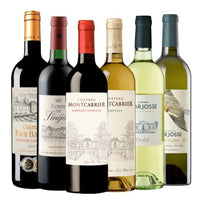
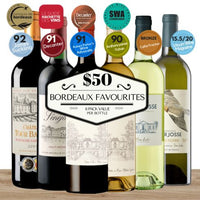

Bordeaux Favourites – 6 Pack
Timeless appeal of France's most celebrated wine region with the Bordeaux Favourites – 6 Pack. This carefully curated collection brings together a selection of outstanding Bordeaux wines from respected châteaux, showcasing the elegance, balance, and complexity that have made Bordeaux famous around the world. From smooth, fruit-driven styles to rich, structured blends, each bottle offers exceptional quality and authentic regional character. Perfect for entertaining, gifting, or expanding your cellar, this collection is an ideal way to enjoy the very best of Bordeaux.
1 x Chateau Tour Bayard Montagne Saint Emilion 2021 - Bordeaux, France
90/100 James Suckling
15.5/20 VertdeVin
Bronze - CellarTracker
Bronze - Jeff Leve, The Wine Cellar Insider
Commended - The Wine Independent
James Suckling "Notes of walnuts, plums, mocha and licorice. It’s medium-bodied, chewy and firm. Remains chewy at the end."
VertdeVin "The nose is elegant, revealing volume, elegance, definition, fine grain and an airiness in its power/small richness. There are notes of pulpy blackberry, pulpy raspberry and more lightly crushed berries combined with touches of fresh vanilla and a subtle hint of star anise. The palate is fruity and offers minerality, a juicy/acidic backbone, good definition, a certain gourmandize, elegance, a nice balance, freshness, a good finesse of the guideline as well as a fine stretch. On the palate this wine expresses juicy/pulpy boysenberry, pulpy/acidic raspberry and more lightly fresh/juicy cherry notes combined with touches of blueberry, nutmeg, fine hints of liquorice, vanilla, a discreet seriousness and a very discreet hint of pepper and a subtle hint of dark chocolate (in the background). Good length. The tannins are precise and mellow. Good persistence."
Jeff Leve, The Wine Cellar Insider "Soft, round and plummy, with a touch minerality that adds complexity on the palate, the wine ends with red plums on the backend."
Chateau Tour Bayard is on two Saint-Emilion satellite appellations: 15 hectares in Montagne Saint-Emilion and 10 hectares in Puisseguin Saint-Emilion. The vineyards are planted on magnificent clay and limestone slopes planted with 80% Merlot, 15% Cabernet Franc and 5% Malbec. Julien Richard took over from his mother Fanny in 2012 and has since been working to protect the estate’s biodiversity using the know-how that he inherited from his grandfather Angelo Nicoletti. Since 1956 the successive generations have made every effort to give priority to the terroir without using any herbicides. Since 2018, the vineyard is certified HEV3 (High Environmental Value), is harvested by hand and is now in conversion to organic farming.
1 x Comte de Senejac Haut-Medoc 2018 - Bordeaux, France
Gold - Berliner Wine Trophy
Bronze - Decanter World Wine Awards (2014 vintage)
A true showcase for the Château, Comte de Sénéjac is made from the estate's young vines and carefully selected plots. Notes of red and black fruit. On the palate, a fine tannic structure perfectly balances the whole. Fine toasted cocoa aromas underline the quality of the ageing process. Comte de Sénéjac is a flavousome wine to be enjoyed young.
70 % Cabernet Sauvignon, 25 % Merlot, 5 % Cabernet Franc
The Sénéjac vineyard lies on a plateau overlooking the commune of Le Pian-Médoc. A former barony, its first known owner was Nicolas de Bloys in the 16th century. In 1999, the estate was given fresh momentum with its acquisition by Lorraine Cordier, also owner of Château Talbot, a Grand Cru Classé of Saint-Julien, with the ambition of raising Sénéjac to the level of the Médoc’s finest wines.
Following her passing, the estate is now run by her sister, Nancy Bignon-Cordier, and the Cordier family.
Château Sénéjac is located in the Haut-Médoc, halfway between Margaux and Bordeaux. With a history dating back to the 16th century, this magnificent estate is now managed by the descendants of Lorraine Cordier, who used to own Grand Cru Classé Château Talbot in Saint Julien. Château Sénéjac covers 150 hectares, of which 41 hectares are planted with vines producing red wines only. Planted on clay-gravel hillsides, the vineyard has 35 years old vines on average with Cabernet Sauvignon, Merlot, Cabernet Franc and Petit Verdot plantings. This blend is then matured in carefully selected French oak barrels. After 12 to 14 months of ageing in wood (of which 30% in new barrels), the wine is bottled. The château is certified High Environmental Value. Comte de Sénéjac is the second wine of Château Sénéjac with intense aromas of red and black fruits, complemented by hints of cacao. Beautifully balanced with silky tannins and roasted notes on the finish.
1 x Chateau Montcabrier Bordeaux Blanc 2022 - Bordeaux, France
Gold - Gilbert & Gaillard International Challenge 2020 (2019 vintage)
Bronze - Global Wine Medal Rating & Vivino Rating (2019 vintage)
Winemaker "Château Montcabrier Bordeaux Blanc is crafted from a blend of Sauvignon Blanc and Sémillon grapes, grown in the renowned Bordeaux region of France. The vineyards benefit from a temperate maritime climate, which promotes balanced ripening and vibrant acidity. The wine is fermented in stainless steel tanks to preserve its fresh, aromatic profile, highlighting notes of citrus and green apple. This Bordeaux Blanc is intended to be enjoyed young, offering a crisp and refreshing drinking experience with a clean finish, making it an ideal companion for seafood and light dishes."
Château Montcabrier is a family-owned estate in Bordeaux dedicated to producing wines that reflect the character and traditions of the region. The winery combines traditional winemaking techniques with modern vineyard practices to ensure quality and consistency across its range. Its philosophy centers on crafting approachable, well-balanced wines that showcase freshness, elegance, and varietal expression. The estate's Bordeaux Blanc is particularly appreciated for its vibrant fruit profile and refreshing style.
Bordeaux, located in southwestern France, is one of the world's most famous wine-producing regions. Its maritime climate, influenced by the nearby Atlantic Ocean, provides mild temperatures and favorable conditions for growing high-quality grapes. The region's diverse soils, including limestone, clay, and gravel, contribute complexity and distinctive character to its wines. Bordeaux is renowned not only for its prestigious red wines but also for its elegant and expressive dry white wines.
Bordeaux Blanc is traditionally crafted from a blend of Sauvignon Blanc and Sémillon, creating wines that are both fresh and well-rounded. Sauvignon Blanc contributes bright acidity and lively aromas of citrus, tropical fruits, and fresh herbs. Sémillon adds richness, texture, and subtle notes of pear, stone fruit, and honey. Together, these varieties produce a harmonious wine with crisp freshness, balanced structure, and excellent food-pairing versatility.
1 x Chateau Marjosse Pierre Lurton Cuvee Palombre White 2020 - Bordeaux, France
92/100 James Suckling
93/100 James Sucking (2019 vintage)
92/100 Jean Marc Quarin (2019 vintage)
Owned by one of the world's most famous winemakers, Pierre Lurton - president of two of Bordeaux's best-known chateaux, the Moët Hennessy Louis Vuitton (LVMH) owned Château Cheval Blanc and Château d’Yquem.
James Suckling, ''..I like the density and concentration, with a delicious creaminess undercut by herb and spice...Almonds, fennel, yoghurt, grapefruit and pear skins on the nose, with some cloves and white pepper.''
Jancis Robinson "Cuvée Palombe, a startlingly rich white based on 45- to 70-year-old vines named after a pigeon. The blend is a third each of Sémillon, Sauvignon Blanc and the more perfumed Sauvignon Gris but seems to me to be dominated by the lovely beeswax and lanolin flavours of fully ripe Sémillon, a grape variety more often encountered in sweet white bordeaux. I originally tasted the wine at room temperature when it seemed almost fat, until a nice cooling breeze of Sauvignon Blanc blew across my palate on the finish. The wine benefited from being restored to the cellar before I tasted it a second time, when it was, again, such a welcome and characterful contrast to the technically perfect Sauvignon-dominated style that has become typical of Bordeaux Blanc." (2019 vintage)
James Suckling, "..Focused and elegant...A medium-to full-bodied white with complex aromas of dried lime, apricot, green mango, flint and toast. It’s textured and creamy with crisp acidity and flinty, subtly smoky layers." (2019 vintage)
Jeff Leve, The Wine Cellar Insider "Flowers, lemon rind, spearmint and honeysuckle notes are all over the place. Fresh, forward, fruity and with a creamy, yellow, citrus rind finish, with just a drizzle of honey, you can enjoy this on release." (2019 vintage)
Château Marjosse is owned by French 'wine royalty', Pierre Lurton - president of two of Bordeaux’s best-known châteaux; the Moët Hennessy Louis Vuitton (LVMH) owned, Château Cheval Blanc and Château d’Yquem, Château Marjosse. Pierre Lurton comes from two of the great Bordeaux families. His father Dominique was the youngest son of the paterfamilias François Lurton; his uncle André Lurton who founded the eponymous wine company; his many cousins run châteaux from Pauillac to Pomerol. His mother is from the famous Lafite family.
The influential Club Enologique asserts that Pierre is the most accomplished wine personality of his famous family. Trained as a doctor but swapping his studies for wine making after four years. At 23 he took over Clos Fourtet in St Emilion, one of the fine Lurton properties, and in 1991 he was appointed head of Château Cheval Blanc (it was bought by Bernard Arnault of LVMH in 1998); in 1999 he took on Château d’Yquem, which had just been added to the Arnault portfolio.
Club Enologique describes Pierre Lurton as having the world’s most corporate wine job. "However he divides his time between two of the world’s most exalted wine properties, but comes down to earth in Entre-deux-Mers, the leafy, unpretentious appellation to the east of Bordeaux at Château Marjosse."
The Château Marjosse estate is located in Entre-deux-Mers, on the right bank of Bordeaux. Initially owned by the wine merchant Bernard Chénier, Château Marjosse was acquired by the Deleuze family, who, in 1990, gave some plots to Pierre Lurton to rent. In 1992, Pierre Lurton, who grew up in Château Reynier, neighbour to this magnificent Chartreuse, moved to a second home in Château Marjosse and, over successive years became the owner of the entire vineyard, as well as the Chartreuse in 2013.
Decanter "Since Lurton bought Château Marjosse in 1994, the estate has improved beyond recognition. Pierre's father, Dominique Lurton, also made over a further 30ha so that, under the Château Marjosse label, Lurton now exploits 42ha of vineyard, six hectares of white and 36ha of Bordeaux red – a total of 300,000 bottles a year. Pierre insists his wine is Bordeaux and not Bordeaux Supérieur because ‘my wine is only supérieur in the bottle’. His objectives are ambitious. As the quality of the terroir with clay-limestone soil is similar to some of the better areas in Saint-Emilion, he hopes to prove that wines from this area can rival those from more prestigious regions."
Sommeliers International "At Château Marjosse the land possesses yet another specific feature, known locally as “la Boulbène”, a silty-clayey texture that has developed on ancient alluvions. The fertility of these soils no longer needs to be proved, because, by chance, they are also found in Saint-Emilion, a terroir that is extremely familiar to the man who manages “Cheval Blanc” …. Pierre Lurton. Assisted in this transformation by Consultant-Oenologist Pascal Poussevin, whose recommendations range from vine growing to wine-making, Pierre Lurton’s estate has now reached its cruising speed … Beyond the fabulous adventures he experiences in his role as manager of Châteaux d’Yquem, Cheval Blanc, as well as estates in South Africa, Latin America and in Australia … it is undoubtedly with “the salt of this land here in the Entre-deux-Mers” that his years of quest for perfection will be revealed. It is clear that this region needs winegrowers of such calibre, those who possess a sixth sense and, using techniques that almost resemble intentional alchemy, transform the grapes they touch into wines that exude the unique character of a specific area."
The Entre-deux-Mers region, nicknamed by wine experts as “Little Tuscany”, is unique and jealously protected by its inhabitants. "There are fifteen appellations that constitute the Entre-deux-Mers. The most well-known of them all, reputed for its dry, lively white wines, is certainly the one which bears the name of this region! The Entre-deux-Mers cultivates a certain speciality in producing white wines, due to its basic geological assets, possessing gravelly-limestone soils, upon which Sémillon, Sauvignon, Muscadelle and even Ugni Blanc grape varieties are planted. But the variety of soils and sub-soils associated with such a complex landscape provides a diversity of terroirs … These are favourable for producing red wines, that are regrettably not sufficiently well-known, but highly prized for the complexity of their aromas, their deep, vivid colour, as well as the concentration and elegance of their tannins." Sommeliers International.
Bordeaux, in the southwest of France, needs little introduction as one of the world's most famous, prestigious and prolific wine regions. Its three trump cards are diversity, quality and quantity. The majority of Bordeaux wines (nearly 90 percent of production volume) are the dry, medium- and full-bodied red Bordeaux Blends that established its reputation. The finest (and most expensive) of these come from the great châteaux of the Haut-Médoc and the Right Bank appellations Saint-Émilion and Pomerol. The legendary reds are complemented by high-quality white wines, both dry styles (particularly from Pessac-Léognan) and the sweet, botrytized nectars of Sauternes.
Sauvignon Gris is a pink-berried mutation of the Sauvignon Blanc grape. It most likely originated around Bordeaux, but has found itself quite at home in Chile. Sauvignon Gris is thinly scattered across other parts of the wine world, including Uruguay, New Zealand, the United States and Switzerland.
Its popularity among growers was historically severely limited by its low yields; in France in 2009 there were (officially) only 463 hectares (1144 acres) of vines. However plantings may be on the increase, in the Loire, in Bordeaux to add body to Sauvignon Blanc, and elsewhere around the world. While the clone is not legally permitted in some Loire appellations – such as Sancerre – it is generally agreed that Sauvignon Gris vines are present in a good number of vineyards in such zones.
Sauvignon Gris is less aromatic than its Sauvignon Blanc sibling, but certainly capable of producing interesting wines. Wines produced from Sauvignon Gris tend to be richer and more voluptuous in texture than Sauvignon Blanc, with ripe fruit flavors of mango and melon as well as citrus notes. The wines are usually dry and tend to have some of the herbaceous notes so typical of the Sauvignon family. The type of color mutation seen in Sauvignon Gris is a naturally occurring phenomenon and reasonably common. For example, Roter Riesling is a pink-skinned mutation of Riesling, Chardonnay Rosé is a mutation of Chardonnay and Pinot Gris is a light-berried variant of Pinot Noir. Sauvignon Gris is also often blended with Sauvignon Blanc, including examples where the former is a minor (usually uncredited) component of New World varietal Sauvignon Blanc wines.
1 x Chateau Montcabrier Bordeaux Superieur Rouge 2018 - Bordeaux, France
Bronze - Sommelier Wine Awards (2017 vintage)
Commended - International Wine Challenge (2016 vintage)
Gold - Concours de Bordeaux Vin d'Aqquitaine (2015 vintage)
Château Montcabrier is a vineyard of the Milhade family estate, Château Recougne, located on the right bank of Bordeaux, in the Fronsadais. This property has produced wine for more than 400 years, and has always been recognized for producing outstanding wine. Its name is said to have come from French King Henri IV, in “recognition” (‘recougne’) of the quality of its wine. The Milhade family purchased the property in the mid 1930s, and Château Recougne has become their flagship estate, producing quintessential Bordeaux each vintage. The work of several generations has positioned Château Recougne as one of the key estates for Bordeaux Supérieur Red wines. The Château Montcabrier’s grapes, harvested and vinified separately from Chateau Recougne, come predominantly from clay and sandy soils and offer a refined style dominated by the freshness of fruits.
Merlot is best suited to the gravelly clay terroir and is the majority planting here, comprising about 80% of the vineyard, complemented by equal parts of both Cabernets. The parcels set aside for Moncabrier include those planted on marley clay, with less gravel, and younger vines throughout the estate. The Milhades employ environmentally friendly viticultural techniques, minimal spraying, low yields through green harvesting, and excellent canopy management.
1 x Chateau Marjosse Pierre Lurton Bordeaux Blanc 2020 - Bordeaux, France
91/100 James Suckling
91/100 Decanter
89-91/100 Robert Parker, The Wine Advocate
Owned by one of the world's most famous winemakers, Pierre Lurton - president of two of Bordeaux's best-known chateaux, the Moët Hennessy Louis Vuitton (LVMH) owned Château Cheval Blanc and Château d’Yquem.
James Suckling "Plenty of sliced-apple, peach and lemon character with a medium body, fresh acidity and a clean, vivid finish. Energetic and ready for the beach!"
Decanter "Well placed and perky fruits, not overly high in acidities but instead given focus by slate texture and a point of bitterness on the finish. Bright fruits keep things mouthwatering. 3% Muscadelle completes the plantings (I don't have the specific 2020 blend). This is an enjoyable Bordeaux Blanc with personality; a successful wine in the category."
Robert Parker, The Wine Advocate "Comes skipping out of the glass with vibrant notes of lime leaves, grapefruit and crushed rocks, giving way to emerging notions of green apples, dill seed, and fresh hay. The medium-bodied palate delivers a great intensity of herbs-laced citrus flavors, supported by a racy backbone and finishing long and chalky."
Château Marjosse is owned by French 'wine royalty', Pierre Lurton - president of two of Bordeaux’s best-known châteaux; the Moët Hennessy Louis Vuitton (LVMH) owned, Château Cheval Blanc and Château d’Yquem, Château Marjosse. Pierre Lurton comes from two of the great Bordeaux families. His father Dominique was the youngest son of the paterfamilias François Lurton; his uncle André Lurton who founded the eponymous wine company; his many cousins run châteaux from Pauillac to Pomerol. His mother is from the famous Lafite family.
The influential Club Enologique asserts that Pierre is the most accomplished wine personality of his famous family. Trained as a doctor but swapping his studies for wine making after four years. At 23 he took over Clos Fourtet in St Emilion, one of the fine Lurton properties, and in 1991 he was appointed head of Château Cheval Blanc (it was bought by Bernard Arnault of LVMH in 1998); in 1999 he took on Château d’Yquem, which had just been added to the Arnault portfolio.
Club Enologique describes Pierre Lurton as having the world’s most corporate wine job. "However he divides his time between two of the world’s most exalted wine properties, but comes down to earth in Entre-deux-Mers, the leafy, unpretentious appellation to the east of Bordeaux at Château Marjosse."
The Château Marjosse estate is located in Entre-deux-Mers, on the right bank of Bordeaux. Initially owned by the wine merchant Bernard Chénier, Château Marjosse was acquired by the Deleuze family, who, in 1990, gave some plots to Pierre Lurton to rent. In 1992, Pierre Lurton, who grew up in Château Reynier, neighbour to this magnificent Chartreuse, moved to a second home in Château Marjosse and, over successive years became the owner of the entire vineyard, as well as the Chartreuse in 2013.
Decanter "Since Lurton bought Château Marjosse in 1994, the estate has improved beyond recognition. Pierre's father, Dominique Lurton, also made over a further 30ha so that, under the Château Marjosse label, Lurton now exploits 42ha of vineyard, six hectares of white and 36ha of Bordeaux red – a total of 300,000 bottles a year. Pierre insists his wine is Bordeaux and not Bordeaux Supérieur because ‘my wine is only supérieur in the bottle’. His objectives are ambitious. As the quality of the terroir with clay-limestone soil is similar to some of the better areas in Saint-Emilion, he hopes to prove that wines from this area can rival those from more prestigious regions."
Sommeliers International "At Château Marjosse the land possesses yet another specific feature, known locally as “la Boulbène”, a silty-clayey texture that has developed on ancient alluvions. The fertility of these soils no longer needs to be proved, because, by chance, they are also found in Saint-Emilion, a terroir that is extremely familiar to the man who manages “Cheval Blanc” …. Pierre Lurton. Assisted in this transformation by Consultant-Oenologist Pascal Poussevin, whose recommendations range from vine growing to wine-making, Pierre Lurton’s estate has now reached its cruising speed … Beyond the fabulous adventures he experiences in his role as manager of Châteaux d’Yquem, Cheval Blanc, as well as estates in South Africa, Latin America and in Australia … it is undoubtedly with “the salt of this land here in the Entre-deux-Mers” that his years of quest for perfection will be revealed. It is clear that this region needs winegrowers of such calibre, those who possess a sixth sense and, using techniques that almost resemble intentional alchemy, transform the grapes they touch into wines that exude the unique character of a specific area."
45% Semillon, 35% Sauvignon-Blanc, 15% Sauvignon Gris, 5% Muscadelle
The Entre-deux-Mers region, nicknamed by wine experts as “Little Tuscany”, is unique and jealously protected by its inhabitants. "There are fifteen appellations that constitute the Entre-deux-Mers. The most well-known of them all, reputed for its dry, lively white wines, is certainly the one which bears the name of this region! The Entre-deux-Mers cultivates a certain speciality in producing white wines, due to its basic geological assets, possessing gravelly-limestone soils, upon which Sémillon, Sauvignon, Muscadelle and even Ugni Blanc grape varieties are planted. But the variety of soils and sub-soils associated with such a complex landscape provides a diversity of terroirs … These are favourable for producing red wines, that are regrettably not sufficiently well-known, but highly prized for the complexity of their aromas, their deep, vivid colour, as well as the concentration and elegance of their tannins." Sommeliers International.
Bordeaux, in the southwest of France, needs little introduction as one of the world's most famous, prestigious and prolific wine regions. Its three trump cards are diversity, quality and quantity. The majority of Bordeaux wines (nearly 90 percent of production volume) are the dry, medium- and full-bodied red Bordeaux Blends that established its reputation. The finest (and most expensive) of these come from the great châteaux of the Haut-Médoc and the Right Bank appellations Saint-Émilion and Pomerol. The legendary reds are complemented by high-quality white wines, both dry styles (particularly from Pessac-Léognan) and the sweet, botrytized nectars of Sauternes.
Timeless appeal of France's most celebrated wine region with the Bordeaux Favourites – 6 Pack. This carefully curated collection brings together a selection of outstanding Bordeaux wines from respected châteaux, showcasing the elegance, balance, and complexity that have made Bordeaux famous around the world. From smooth, fruit-driven styles to rich, structured blends, each bottle offers exceptional quality and authentic regional character. Perfect for entertaining, gifting, or expanding your cellar, this collection is an ideal way to enjoy the very best of Bordeaux.
1 x Chateau Tour Bayard Montagne Saint Emilion 2021 - Bordeaux, France
90/100 James Suckling
15.5/20 VertdeVin
Bronze - CellarTracker
Bronze - Jeff Leve, The Wine Cellar Insider
Commended - The Wine Independent
James Suckling "Notes of walnuts, plums, mocha and licorice. It’s medium-bodied, chewy and firm. Remains chewy at the end."
VertdeVin "The nose is elegant, revealing volume, elegance, definition, fine grain and an airiness in its power/small richness. There are notes of pulpy blackberry, pulpy raspberry and more lightly crushed berries combined with touches of fresh vanilla and a subtle hint of star anise. The palate is fruity and offers minerality, a juicy/acidic backbone, good definition, a certain gourmandize, elegance, a nice balance, freshness, a good finesse of the guideline as well as a fine stretch. On the palate this wine expresses juicy/pulpy boysenberry, pulpy/acidic raspberry and more lightly fresh/juicy cherry notes combined with touches of blueberry, nutmeg, fine hints of liquorice, vanilla, a discreet seriousness and a very discreet hint of pepper and a subtle hint of dark chocolate (in the background). Good length. The tannins are precise and mellow. Good persistence."
Jeff Leve, The Wine Cellar Insider "Soft, round and plummy, with a touch minerality that adds complexity on the palate, the wine ends with red plums on the backend."
Chateau Tour Bayard is on two Saint-Emilion satellite appellations: 15 hectares in Montagne Saint-Emilion and 10 hectares in Puisseguin Saint-Emilion. The vineyards are planted on magnificent clay and limestone slopes planted with 80% Merlot, 15% Cabernet Franc and 5% Malbec. Julien Richard took over from his mother Fanny in 2012 and has since been working to protect the estate’s biodiversity using the know-how that he inherited from his grandfather Angelo Nicoletti. Since 1956 the successive generations have made every effort to give priority to the terroir without using any herbicides. Since 2018, the vineyard is certified HEV3 (High Environmental Value), is harvested by hand and is now in conversion to organic farming.
1 x Comte de Senejac Haut-Medoc 2018 - Bordeaux, France
Gold - Berliner Wine Trophy
Bronze - Decanter World Wine Awards (2014 vintage)
A true showcase for the Château, Comte de Sénéjac is made from the estate's young vines and carefully selected plots. Notes of red and black fruit. On the palate, a fine tannic structure perfectly balances the whole. Fine toasted cocoa aromas underline the quality of the ageing process. Comte de Sénéjac is a flavousome wine to be enjoyed young.
70 % Cabernet Sauvignon, 25 % Merlot, 5 % Cabernet Franc
The Sénéjac vineyard lies on a plateau overlooking the commune of Le Pian-Médoc. A former barony, its first known owner was Nicolas de Bloys in the 16th century. In 1999, the estate was given fresh momentum with its acquisition by Lorraine Cordier, also owner of Château Talbot, a Grand Cru Classé of Saint-Julien, with the ambition of raising Sénéjac to the level of the Médoc’s finest wines.
Following her passing, the estate is now run by her sister, Nancy Bignon-Cordier, and the Cordier family.
Château Sénéjac is located in the Haut-Médoc, halfway between Margaux and Bordeaux. With a history dating back to the 16th century, this magnificent estate is now managed by the descendants of Lorraine Cordier, who used to own Grand Cru Classé Château Talbot in Saint Julien. Château Sénéjac covers 150 hectares, of which 41 hectares are planted with vines producing red wines only. Planted on clay-gravel hillsides, the vineyard has 35 years old vines on average with Cabernet Sauvignon, Merlot, Cabernet Franc and Petit Verdot plantings. This blend is then matured in carefully selected French oak barrels. After 12 to 14 months of ageing in wood (of which 30% in new barrels), the wine is bottled. The château is certified High Environmental Value. Comte de Sénéjac is the second wine of Château Sénéjac with intense aromas of red and black fruits, complemented by hints of cacao. Beautifully balanced with silky tannins and roasted notes on the finish.
1 x Chateau Montcabrier Bordeaux Blanc 2022 - Bordeaux, France
Gold - Gilbert & Gaillard International Challenge 2020 (2019 vintage)
Bronze - Global Wine Medal Rating & Vivino Rating (2019 vintage)
Winemaker "Château Montcabrier Bordeaux Blanc is crafted from a blend of Sauvignon Blanc and Sémillon grapes, grown in the renowned Bordeaux region of France. The vineyards benefit from a temperate maritime climate, which promotes balanced ripening and vibrant acidity. The wine is fermented in stainless steel tanks to preserve its fresh, aromatic profile, highlighting notes of citrus and green apple. This Bordeaux Blanc is intended to be enjoyed young, offering a crisp and refreshing drinking experience with a clean finish, making it an ideal companion for seafood and light dishes."
Château Montcabrier is a family-owned estate in Bordeaux dedicated to producing wines that reflect the character and traditions of the region. The winery combines traditional winemaking techniques with modern vineyard practices to ensure quality and consistency across its range. Its philosophy centers on crafting approachable, well-balanced wines that showcase freshness, elegance, and varietal expression. The estate's Bordeaux Blanc is particularly appreciated for its vibrant fruit profile and refreshing style.
Bordeaux, located in southwestern France, is one of the world's most famous wine-producing regions. Its maritime climate, influenced by the nearby Atlantic Ocean, provides mild temperatures and favorable conditions for growing high-quality grapes. The region's diverse soils, including limestone, clay, and gravel, contribute complexity and distinctive character to its wines. Bordeaux is renowned not only for its prestigious red wines but also for its elegant and expressive dry white wines.
Bordeaux Blanc is traditionally crafted from a blend of Sauvignon Blanc and Sémillon, creating wines that are both fresh and well-rounded. Sauvignon Blanc contributes bright acidity and lively aromas of citrus, tropical fruits, and fresh herbs. Sémillon adds richness, texture, and subtle notes of pear, stone fruit, and honey. Together, these varieties produce a harmonious wine with crisp freshness, balanced structure, and excellent food-pairing versatility.
1 x Chateau Marjosse Pierre Lurton Cuvee Palombre White 2020 - Bordeaux, France
92/100 James Suckling
93/100 James Sucking (2019 vintage)
92/100 Jean Marc Quarin (2019 vintage)
Owned by one of the world's most famous winemakers, Pierre Lurton - president of two of Bordeaux's best-known chateaux, the Moët Hennessy Louis Vuitton (LVMH) owned Château Cheval Blanc and Château d’Yquem.
James Suckling, ''..I like the density and concentration, with a delicious creaminess undercut by herb and spice...Almonds, fennel, yoghurt, grapefruit and pear skins on the nose, with some cloves and white pepper.''
Jancis Robinson "Cuvée Palombe, a startlingly rich white based on 45- to 70-year-old vines named after a pigeon. The blend is a third each of Sémillon, Sauvignon Blanc and the more perfumed Sauvignon Gris but seems to me to be dominated by the lovely beeswax and lanolin flavours of fully ripe Sémillon, a grape variety more often encountered in sweet white bordeaux. I originally tasted the wine at room temperature when it seemed almost fat, until a nice cooling breeze of Sauvignon Blanc blew across my palate on the finish. The wine benefited from being restored to the cellar before I tasted it a second time, when it was, again, such a welcome and characterful contrast to the technically perfect Sauvignon-dominated style that has become typical of Bordeaux Blanc." (2019 vintage)
James Suckling, "..Focused and elegant...A medium-to full-bodied white with complex aromas of dried lime, apricot, green mango, flint and toast. It’s textured and creamy with crisp acidity and flinty, subtly smoky layers." (2019 vintage)
Jeff Leve, The Wine Cellar Insider "Flowers, lemon rind, spearmint and honeysuckle notes are all over the place. Fresh, forward, fruity and with a creamy, yellow, citrus rind finish, with just a drizzle of honey, you can enjoy this on release." (2019 vintage)
Château Marjosse is owned by French 'wine royalty', Pierre Lurton - president of two of Bordeaux’s best-known châteaux; the Moët Hennessy Louis Vuitton (LVMH) owned, Château Cheval Blanc and Château d’Yquem, Château Marjosse. Pierre Lurton comes from two of the great Bordeaux families. His father Dominique was the youngest son of the paterfamilias François Lurton; his uncle André Lurton who founded the eponymous wine company; his many cousins run châteaux from Pauillac to Pomerol. His mother is from the famous Lafite family.
The influential Club Enologique asserts that Pierre is the most accomplished wine personality of his famous family. Trained as a doctor but swapping his studies for wine making after four years. At 23 he took over Clos Fourtet in St Emilion, one of the fine Lurton properties, and in 1991 he was appointed head of Château Cheval Blanc (it was bought by Bernard Arnault of LVMH in 1998); in 1999 he took on Château d’Yquem, which had just been added to the Arnault portfolio.
Club Enologique describes Pierre Lurton as having the world’s most corporate wine job. "However he divides his time between two of the world’s most exalted wine properties, but comes down to earth in Entre-deux-Mers, the leafy, unpretentious appellation to the east of Bordeaux at Château Marjosse."
The Château Marjosse estate is located in Entre-deux-Mers, on the right bank of Bordeaux. Initially owned by the wine merchant Bernard Chénier, Château Marjosse was acquired by the Deleuze family, who, in 1990, gave some plots to Pierre Lurton to rent. In 1992, Pierre Lurton, who grew up in Château Reynier, neighbour to this magnificent Chartreuse, moved to a second home in Château Marjosse and, over successive years became the owner of the entire vineyard, as well as the Chartreuse in 2013.
Decanter "Since Lurton bought Château Marjosse in 1994, the estate has improved beyond recognition. Pierre's father, Dominique Lurton, also made over a further 30ha so that, under the Château Marjosse label, Lurton now exploits 42ha of vineyard, six hectares of white and 36ha of Bordeaux red – a total of 300,000 bottles a year. Pierre insists his wine is Bordeaux and not Bordeaux Supérieur because ‘my wine is only supérieur in the bottle’. His objectives are ambitious. As the quality of the terroir with clay-limestone soil is similar to some of the better areas in Saint-Emilion, he hopes to prove that wines from this area can rival those from more prestigious regions."
Sommeliers International "At Château Marjosse the land possesses yet another specific feature, known locally as “la Boulbène”, a silty-clayey texture that has developed on ancient alluvions. The fertility of these soils no longer needs to be proved, because, by chance, they are also found in Saint-Emilion, a terroir that is extremely familiar to the man who manages “Cheval Blanc” …. Pierre Lurton. Assisted in this transformation by Consultant-Oenologist Pascal Poussevin, whose recommendations range from vine growing to wine-making, Pierre Lurton’s estate has now reached its cruising speed … Beyond the fabulous adventures he experiences in his role as manager of Châteaux d’Yquem, Cheval Blanc, as well as estates in South Africa, Latin America and in Australia … it is undoubtedly with “the salt of this land here in the Entre-deux-Mers” that his years of quest for perfection will be revealed. It is clear that this region needs winegrowers of such calibre, those who possess a sixth sense and, using techniques that almost resemble intentional alchemy, transform the grapes they touch into wines that exude the unique character of a specific area."
The Entre-deux-Mers region, nicknamed by wine experts as “Little Tuscany”, is unique and jealously protected by its inhabitants. "There are fifteen appellations that constitute the Entre-deux-Mers. The most well-known of them all, reputed for its dry, lively white wines, is certainly the one which bears the name of this region! The Entre-deux-Mers cultivates a certain speciality in producing white wines, due to its basic geological assets, possessing gravelly-limestone soils, upon which Sémillon, Sauvignon, Muscadelle and even Ugni Blanc grape varieties are planted. But the variety of soils and sub-soils associated with such a complex landscape provides a diversity of terroirs … These are favourable for producing red wines, that are regrettably not sufficiently well-known, but highly prized for the complexity of their aromas, their deep, vivid colour, as well as the concentration and elegance of their tannins." Sommeliers International.
Bordeaux, in the southwest of France, needs little introduction as one of the world's most famous, prestigious and prolific wine regions. Its three trump cards are diversity, quality and quantity. The majority of Bordeaux wines (nearly 90 percent of production volume) are the dry, medium- and full-bodied red Bordeaux Blends that established its reputation. The finest (and most expensive) of these come from the great châteaux of the Haut-Médoc and the Right Bank appellations Saint-Émilion and Pomerol. The legendary reds are complemented by high-quality white wines, both dry styles (particularly from Pessac-Léognan) and the sweet, botrytized nectars of Sauternes.
Sauvignon Gris is a pink-berried mutation of the Sauvignon Blanc grape. It most likely originated around Bordeaux, but has found itself quite at home in Chile. Sauvignon Gris is thinly scattered across other parts of the wine world, including Uruguay, New Zealand, the United States and Switzerland.
Its popularity among growers was historically severely limited by its low yields; in France in 2009 there were (officially) only 463 hectares (1144 acres) of vines. However plantings may be on the increase, in the Loire, in Bordeaux to add body to Sauvignon Blanc, and elsewhere around the world. While the clone is not legally permitted in some Loire appellations – such as Sancerre – it is generally agreed that Sauvignon Gris vines are present in a good number of vineyards in such zones.
Sauvignon Gris is less aromatic than its Sauvignon Blanc sibling, but certainly capable of producing interesting wines. Wines produced from Sauvignon Gris tend to be richer and more voluptuous in texture than Sauvignon Blanc, with ripe fruit flavors of mango and melon as well as citrus notes. The wines are usually dry and tend to have some of the herbaceous notes so typical of the Sauvignon family. The type of color mutation seen in Sauvignon Gris is a naturally occurring phenomenon and reasonably common. For example, Roter Riesling is a pink-skinned mutation of Riesling, Chardonnay Rosé is a mutation of Chardonnay and Pinot Gris is a light-berried variant of Pinot Noir. Sauvignon Gris is also often blended with Sauvignon Blanc, including examples where the former is a minor (usually uncredited) component of New World varietal Sauvignon Blanc wines.
1 x Chateau Montcabrier Bordeaux Superieur Rouge 2018 - Bordeaux, France
Bronze - Sommelier Wine Awards (2017 vintage)
Commended - International Wine Challenge (2016 vintage)
Gold - Concours de Bordeaux Vin d'Aqquitaine (2015 vintage)
Château Montcabrier is a vineyard of the Milhade family estate, Château Recougne, located on the right bank of Bordeaux, in the Fronsadais. This property has produced wine for more than 400 years, and has always been recognized for producing outstanding wine. Its name is said to have come from French King Henri IV, in “recognition” (‘recougne’) of the quality of its wine. The Milhade family purchased the property in the mid 1930s, and Château Recougne has become their flagship estate, producing quintessential Bordeaux each vintage. The work of several generations has positioned Château Recougne as one of the key estates for Bordeaux Supérieur Red wines. The Château Montcabrier’s grapes, harvested and vinified separately from Chateau Recougne, come predominantly from clay and sandy soils and offer a refined style dominated by the freshness of fruits.
Merlot is best suited to the gravelly clay terroir and is the majority planting here, comprising about 80% of the vineyard, complemented by equal parts of both Cabernets. The parcels set aside for Moncabrier include those planted on marley clay, with less gravel, and younger vines throughout the estate. The Milhades employ environmentally friendly viticultural techniques, minimal spraying, low yields through green harvesting, and excellent canopy management.
1 x Chateau Marjosse Pierre Lurton Bordeaux Blanc 2020 - Bordeaux, France
91/100 James Suckling
91/100 Decanter
89-91/100 Robert Parker, The Wine Advocate
Owned by one of the world's most famous winemakers, Pierre Lurton - president of two of Bordeaux's best-known chateaux, the Moët Hennessy Louis Vuitton (LVMH) owned Château Cheval Blanc and Château d’Yquem.
James Suckling "Plenty of sliced-apple, peach and lemon character with a medium body, fresh acidity and a clean, vivid finish. Energetic and ready for the beach!"
Decanter "Well placed and perky fruits, not overly high in acidities but instead given focus by slate texture and a point of bitterness on the finish. Bright fruits keep things mouthwatering. 3% Muscadelle completes the plantings (I don't have the specific 2020 blend). This is an enjoyable Bordeaux Blanc with personality; a successful wine in the category."
Robert Parker, The Wine Advocate "Comes skipping out of the glass with vibrant notes of lime leaves, grapefruit and crushed rocks, giving way to emerging notions of green apples, dill seed, and fresh hay. The medium-bodied palate delivers a great intensity of herbs-laced citrus flavors, supported by a racy backbone and finishing long and chalky."
Château Marjosse is owned by French 'wine royalty', Pierre Lurton - president of two of Bordeaux’s best-known châteaux; the Moët Hennessy Louis Vuitton (LVMH) owned, Château Cheval Blanc and Château d’Yquem, Château Marjosse. Pierre Lurton comes from two of the great Bordeaux families. His father Dominique was the youngest son of the paterfamilias François Lurton; his uncle André Lurton who founded the eponymous wine company; his many cousins run châteaux from Pauillac to Pomerol. His mother is from the famous Lafite family.
The influential Club Enologique asserts that Pierre is the most accomplished wine personality of his famous family. Trained as a doctor but swapping his studies for wine making after four years. At 23 he took over Clos Fourtet in St Emilion, one of the fine Lurton properties, and in 1991 he was appointed head of Château Cheval Blanc (it was bought by Bernard Arnault of LVMH in 1998); in 1999 he took on Château d’Yquem, which had just been added to the Arnault portfolio.
Club Enologique describes Pierre Lurton as having the world’s most corporate wine job. "However he divides his time between two of the world’s most exalted wine properties, but comes down to earth in Entre-deux-Mers, the leafy, unpretentious appellation to the east of Bordeaux at Château Marjosse."
The Château Marjosse estate is located in Entre-deux-Mers, on the right bank of Bordeaux. Initially owned by the wine merchant Bernard Chénier, Château Marjosse was acquired by the Deleuze family, who, in 1990, gave some plots to Pierre Lurton to rent. In 1992, Pierre Lurton, who grew up in Château Reynier, neighbour to this magnificent Chartreuse, moved to a second home in Château Marjosse and, over successive years became the owner of the entire vineyard, as well as the Chartreuse in 2013.
Decanter "Since Lurton bought Château Marjosse in 1994, the estate has improved beyond recognition. Pierre's father, Dominique Lurton, also made over a further 30ha so that, under the Château Marjosse label, Lurton now exploits 42ha of vineyard, six hectares of white and 36ha of Bordeaux red – a total of 300,000 bottles a year. Pierre insists his wine is Bordeaux and not Bordeaux Supérieur because ‘my wine is only supérieur in the bottle’. His objectives are ambitious. As the quality of the terroir with clay-limestone soil is similar to some of the better areas in Saint-Emilion, he hopes to prove that wines from this area can rival those from more prestigious regions."
Sommeliers International "At Château Marjosse the land possesses yet another specific feature, known locally as “la Boulbène”, a silty-clayey texture that has developed on ancient alluvions. The fertility of these soils no longer needs to be proved, because, by chance, they are also found in Saint-Emilion, a terroir that is extremely familiar to the man who manages “Cheval Blanc” …. Pierre Lurton. Assisted in this transformation by Consultant-Oenologist Pascal Poussevin, whose recommendations range from vine growing to wine-making, Pierre Lurton’s estate has now reached its cruising speed … Beyond the fabulous adventures he experiences in his role as manager of Châteaux d’Yquem, Cheval Blanc, as well as estates in South Africa, Latin America and in Australia … it is undoubtedly with “the salt of this land here in the Entre-deux-Mers” that his years of quest for perfection will be revealed. It is clear that this region needs winegrowers of such calibre, those who possess a sixth sense and, using techniques that almost resemble intentional alchemy, transform the grapes they touch into wines that exude the unique character of a specific area."
45% Semillon, 35% Sauvignon-Blanc, 15% Sauvignon Gris, 5% Muscadelle
The Entre-deux-Mers region, nicknamed by wine experts as “Little Tuscany”, is unique and jealously protected by its inhabitants. "There are fifteen appellations that constitute the Entre-deux-Mers. The most well-known of them all, reputed for its dry, lively white wines, is certainly the one which bears the name of this region! The Entre-deux-Mers cultivates a certain speciality in producing white wines, due to its basic geological assets, possessing gravelly-limestone soils, upon which Sémillon, Sauvignon, Muscadelle and even Ugni Blanc grape varieties are planted. But the variety of soils and sub-soils associated with such a complex landscape provides a diversity of terroirs … These are favourable for producing red wines, that are regrettably not sufficiently well-known, but highly prized for the complexity of their aromas, their deep, vivid colour, as well as the concentration and elegance of their tannins." Sommeliers International.
Bordeaux, in the southwest of France, needs little introduction as one of the world's most famous, prestigious and prolific wine regions. Its three trump cards are diversity, quality and quantity. The majority of Bordeaux wines (nearly 90 percent of production volume) are the dry, medium- and full-bodied red Bordeaux Blends that established its reputation. The finest (and most expensive) of these come from the great châteaux of the Haut-Médoc and the Right Bank appellations Saint-Émilion and Pomerol. The legendary reds are complemented by high-quality white wines, both dry styles (particularly from Pessac-Léognan) and the sweet, botrytized nectars of Sauternes.