


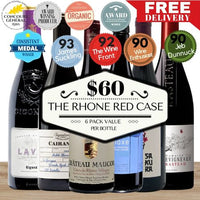
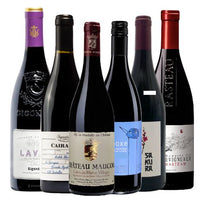
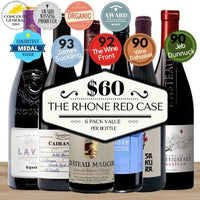
The Rhône Red Wine Case
The Rhône Red Wine Case, featuring six carefully selected red wines from this renowned wine region. Known for their rich fruit flavours, inviting aromas, and distinctive styles, these wines are ideal for sharing over meals, entertaining guests, or adding to your personal wine collection. A wonderful choice for French wine lovers and those looking to explore the diversity of Rhône reds.
1 x Chateau Maucoil Côtes du Rhône Villages Red (Organic) 2023 - Rhone, France
90/100 James Suckling (2021 vintage)
90/100 Matt Walls, Decanter (2020 vintage)
Gold - General Agriculture Competition Paris (2021 vintage)
Gold - Organic Millesime Challenge (2020 vintage)
Organic
James Suckling "The bouquet of summer flowers, Mediterranean herbs, ripe blackberries and leather makes this stand out in the context of the rather challenging 2021 vintage. Good depth, rather supple tannins for this appellation and the smooth finish make this really satisfying. From organically grown grapes." (2021 vintage)
Joe Czerwinski, The Wine Advocate "A solid value, the 2021 Cotes du Rhone Villages is based on Grenache and Mourvèdre from near Jonquières and Syrah from the vicinity of the chateau. Offering up pretty floral shadings, strawberries, raspberries and a hint of tree bark, this easy-drinking beauty is medium-bodied, supple and silky, marked by elegant notions of red berries on the finish." (2021 vintage)
The history of Château Maucoil began several centuries ago. Ancient documents state that its first occupants were Romans who set up a base for Caesar’s legions. Later, Joseph de La Pise, Lord of Maucoil and archivist of the House of Orange-Nassau, the Dutch royal family, inherited the estate and the castle which was built in 1624. From then on, winegrowing became an intrinsic part of the history of Château Maucoil.
The 45 hectares of vines in the Châteauneuf-du-Pape appellation have been organic agriculture since 2011. Château Maucoil uses ancient methods such as furrowing, forming mounds and ploughing to tend the vineyard.
Originally from Bordeaux, the Lavau family who now own Château Maucoil, have been involved with winemaking for generations, and have had vineyards ranging from Bordeaux to Tunisia. In 1964 they were seduced by the richness and quality of the Provencal soil and settled down to make wine in the Rhone Valley.
1 x Michel Chavarin Cairanne “Les Garrigues”s (Organic) 2018 - Rhone Valley, France
90/100 Jeb Dunnuck
Jeb Dunnuck "Coming from the red clay soils of the Les Garrigues lieu-dit, the 2016 Cairanne was aged all in concrete tanks. It has a lovely perfume of seet cherries and raspberry fruits, lavender, pepper and earthly garrigue and it's medium-bodied, rounded and incredibly charming on the palate. Drink this forward, fleshy pleasure bent beauty anytime over the coming 4-5 years." (2016 Vintage)
Clos des Centenaires was founded Luc Baudet of Chateau Mas-Neuf fame, and Californian wine industry veteran, Jack Edwards who both share a passion for artisan wines and the terroir of France’s Southern Rhone.
Clos des Centenaires is a historic vineyard situated in Costieres de Nimes, close to the Mediterranean Sea. The vineyard boasts 70-year-old Grenache vines which are deeply rooted in the pebble stones overlooking the picturesque lakes of Petite Camargue. The vineyard also features Cabernet Sauvignon, Petite Verdot, and Cinsault, and is known for producing unique, high-end, elegant wines of excellent value.
The vineyard soils are cultivated amongst natural grassland using shallow tillage methods and special attention is paid to the revitalization of vines (using annually prepared biodynamic compost). Inputs are limited to organically approved natural products.
The Rhone Valley is one of France's key wine regions and is divided neatly by a gap of about 25 miles (40km). Wines from the northern part of the valley tend to be Syrah-dominant (Hermitage and Cote Rotie being the most notable examples), while wines from the southern Rhone are more commonly blends, with Grenache playing a more dominant role. Chateauneuf-du-Pape is the most famous example of a southern Rhone blend, but similar blends are found in wines from Gigondas, Vacqueyras, and the regional Cotes du Rhone title.
Initially part of the Côtes-du-Rhône Villages AOC, Cairanne vineyards produced some of the best grapes and wines in the region. It is due to this supremacy that most of the Cairanne vineyards have been provisionally elevated to AOC status in February 2016, and definitively given the AOC status in 2018. Today, Cairanne red wines are known for being full-bodied, fruity, spicy with a smooth finish.
Southern Rhone Red Blend refers to a wide range of grape varieties often blended together to make wines in the southern reaches of the Rhone Valley in the south of France. While the blend could theoretically consist of any of a wide range of grape varieties, it is usually made up of Grenache, Syrah and Mourvedre, in varying proportions, typically with Grenache and Syrah as the dominant partners.
1 x Domaine des Evigneaux Rouge 2019 - Rasteau, France
93/100 James Suckling
92/100 Wine Enthusiast
2 Stars - Bettane & Desseauve
Gold - Paris General Agricultural Competition
Bronze - Decanter World Wine Awards
James Suckling "Full and spicy nose with touches of smoked bacon and terracotta. Although endowed with good concentration, this Rasteau is not marked by power with a fresh and elegant palate which ends with a nice interplay of fine tannins and mineral freshness. Blend of Grenache and Syrah. To enjoy or to keep."
Wine Enthusiast "Savory notes of crushed earth and hints of clay accentuate the decadent flavors of blackberry and raspberry jam in this textured and balanced blend of Grenache, Syrah, Carignan, Mourvèdre and Cinsault. Outperforming and consistent among the Rasteaus, it shows the complexity of the exciting vintage terroir."
Decanter World Wine Awards "Obvious oak, with sweet spices and caramelly fruit. Juicy palate, with good concentration and grippy tannins."
50% Grenache, 30% Syrah, 10% Carignan, 5% Mourvèdre, 5% Cinsault
Alcohol: 14.5%
The Domaine Les Évigneaux extends over 10 hectares in Rasteau, a charming village in the south of the Rhône Valley. Perched on a hill facing the Dentelles de Montmirail, the rugged terrain of the Rasteau vineyard offers a great diversity of soils and a colorful landscape. From one terrace to another, along the slopes, we go from clay-limestone soil to blue marl, from rolled pebbles to red marl. With more than fifteen plots spread across the entire Rasteau appellation, our Domaine takes full advantage of this geological diversity which has made the reputation of this Rhône Valley Cru.
Originally from Bordeaux, the Lavau family has been involved with winemaking for generations, and have had vineyards ranging from Bordeaux to Tunisia. In 1964 they were seduced by the richness and quality of the Provencal soil, and settled down to make wine in the Rhone Valley.
1 x Domaine Duseigneur Sakura Rouge 2022 - Rhone, France
Organic
Winemaker "the color is dark purple. The nose is fine, intense, on sloe, cherry stone; pepper and sweet spices. The palate is round, ample, velvety, with a pulpy/juicy texture with expressive fruit, and a more vegetal touch. The latter is accentuated on the finish, reinforced by the bitterness of the stone, complemented by a delicious black fruit."
Syrah 100%
Alcohol: 13%
In Japan, cherry blossoms are considered symbols of evolution, change and transition. They mean that we should not get attached to things because time always moves forward, and we are bound to lose them.
The Samurais made this tattoo to remind us that life was fragile, and that they could lose it at any moment.
Bernard Duseigneur "Seizing the opportunity that nature gives us; that is the essence of biodynamics for me"
Bernard Duseigneur, hailing from a lineage of winemakers, assumed control of the family's domaine in 2002 after a stint in investment banking. Returning to his Mediterranean origins, he continued the legacy of his father and brother, ultimately settling in Châteauneuf-du-Pape on the left bank of the Rhône.
In Châteauneuf-du-Pape, the terroir isn't solely defined by iconic orange pebbles; it comprises diverse soils like red clays, limestone, sandstone sands, and loams from the Rhone's banks. Acknowledging that exceptional terroir alone isn't enough for quality wines, Bernard prioritizes soil vitality. His team nurtures a diverse flora and fauna that mobilize trace elements, fostering symbiosis between plant and soil.
1 x Lavau Gigondas Red 2018 - Rhone, France
93/100 James Suckling
90/100 Jeb Dunnuck
90/100 Wine Enthusiast
Silver - Concours Mondial de Bruxelles (2014 Vintage)
Top 100 #72 - Wine Spectator (2013 Vintage)
Gold - Concours General Agricole Paris (2002 Vintage)
50% Grenache, 10% Mourvèdre, 40% Syrah
James Suckling "Yum. Lovely ripe strawberries, earth, stone and hints of nuts and mushrooms. It’s full-bodied, yet balanced and extremely drinkable."
Jeb Dunnuck "Starting with the 2018 Gigondas, this beautiful, sexy, incredibly Provençal 2018 has a great nose of red plums, blueberries, peppery herbs, and violets. With no hard edges, the vintage’s charming, ready-to-go style, and a good finish"
The Winemaker "Deep nose dominated by spices (pepper, nutmeg) typical of its appellation, which highlights the aromas of blackcurrant and raspberry jam.The mouth has a solid but well-coated structure, volume and a very nice length."
Originally from Bordeaux, the Lavau family has been involved with winemaking for generations, and have had vineyards ranging from Bordeaux to Tunisia. In 1964 they were seduced by the richness and quality of the Provencal soil, and settled down to make wine in the Rhone Valley.
The cellars of Lavau are currently managed by Benoit and Frederic Lavau, who work in partnership with 350 different grape growers. Benoit is a frequent visitor to Singapore and Pop Up Wine events.
Located in France's Southern Rhône, Gigondas produces wines that are rich Grenache-based blends, due in part to the region’s Mediterranean climate and red clay-alluvial soils. Under the AOP regulations, only red and rosé wines may be produced; white wines are simply declassified to Côtes-du-Rhône status. A mandated 50% Grenache is required in the wine, with Mourvèdre and/or Syrah usually accounting for the bulk of the remaining blend—adding structure, savory tones and color intensity to Grenache’s alcoholic power and lush richness. These wines are often compared to the great wines of Châteauneuf-du-Pape, but can even offer better value.
Grenache – Syrah – Mourvedre blended wines – commonly known by the acronym GSM – are the particular specialty of the southern Rhone Valley in France. Grenache and Syrah are key in this part of the world, and are complemented in this instance by the addition of Mourvedre: an important but slightly less famous inclusion to the blend. GSM wines, which have been readily adopted by the New World, are rich, full bodied and leathery, and are characterized by flavors of dark fruit and spice.
1 x Equis Croze Hemitage Equinoxe Maxime Graillot 2018 - Rhone, France
90/100 Robert Parker's Wine Advocate
90/100 Wine Spectator
15.5/20 Jancis Robinson
Richard Hemming "Raw, youthful black fruit on the nose, then charming meat and olive notes on the palate. Proper Syrah, with elegance and perfume and length."
Wine Spectator "Juicy and direct, featuring plum and cherry paste notes gilded with a floral hint.'
100% Syrah
Organic wines are made from grapes grown without pesticides, following strict organic standards. Organic wines are produced in vineyards that do not use synthetic chemicals. Certified organic wines in France.
There are few names as revered in the Northern Rhône as the name Graillot. Maxime Graillot, son of the famed winemaker, Alain Graillot has not only taken over the daily operations of his father's estate but also founded this boutique label with his long-term friend and respected wine-maker Thomas Schmittel. Both work closely with quality growers too and influence successfully winemaking process vinifying, ageing, and bottling. Maxime's devotion to the art of making hauntingly delicious Syrah has been rewarded with an ever-growing and highly dedicated following around the world. And so it would seem quite the daunting task for the child of such a luminary to follow in the footsteps of such a giant. Well luckily for us and the wine world.
There are three wines in the range, each crop sourced from a roster of first-rate, cultivated vineyards where Graillot and Schmittel have a close working relationship with the growers.
In terms of volume, Equinoxe Crozes-Hermitage is the ‘poster wine’ of the project. The fruit for this early-drinking Crozes is sourced from a mature, gravelly and organically farmed site in Pont de l’Isère that has not seen any herbicide or pesticide for 10 years.
Maxime and Thomas pay close attention to what is happening in the vineyard all year long, decide when to harvest, the way they harvest and the way they make the wine once back at the winery (in Pont de l’Isère). They are very hands-on and take the time to have a relationship with the growers.
The Rhone Valley is a key wine-producing region in the southeast of France. Crozes-Hermitage is an appellation of the northern Rhone valley in France. It covers a relatively large area on the eastern bank of the Rhone river, to the north and south of Tain L'Hermitage town. Much larger than the prestigious Hermitage appellation which it surrounds, Crozes-Hermitage is also much more prolific. In 2011 almost 70,000 hl of wine were produced and sold under the Crozes-Hermitage title – more than the other seven northern Rhone appellations combined.
Syrah is a dark-skinned red wine grape. Its origins have been popularly debated, but its modern viticultural home is unquestionably the northern Rhône Valley of eastern France. In Australia, Syrah is the flagship variety and has developed such a distinct personality that it is essentially regarded as a distinct variety, is overwhelmingly (but not exclusively) known as Shiraz.